Are you wondering what to wear for your first trip to Sri Lanka?
Sri Lanka is often described as having a year-round tropical climate, but in reality Heat countermeasures not only Insect repellent measures や Sun protectionand when visiting religious facilities Dress Code There are many points you should be aware of.
It would be a shame to go unprepared and find yourself unable to enter the temple or exhausted by the heat, wouldn't it?
Rest assured! In this article,For first-time Japanese visitorsWe comprehensively cover clothing essentials for Sri Lanka's climate throughout the year, providing thorough guidance on selecting appropriate attire for different occasions.
We've included tips on what to wear for both women and men, along with handy bits of knowledge to avoid mishaps while travelling. Read this and you'll...My clothing preparations for the Sri Lanka trip are perfect。
Discover all the secrets to enjoying a comfortable and safe tropical holiday!
Right then, let's get started!
- Key points regarding Sri Lanka's climate and clothing
- Differences in Clothing by Climate and Season (Comparison Table)
- Essential Clothing and Items for Different Sightseeing Scenarios
- What to Wear on a Trip to Sri Lanka [Women's Edition]
- Clothing for Travel in Sri Lanka [Men's Edition]
- Clothing Selection Q&A: Common Questions Compiled
- Summary: Key points to note regarding clothing in Sri Lanka
Key points regarding Sri Lanka's climate and clothing
Sri Lanka is close to the equator Tropical monsoon climate country.
To put it simply, "Throughout the year, Japan's midsummerIt's perfectly acceptable to think that, but depending on the region and time of yeardry seasonとrainy seasonand the weather will change.
First, let's grasp the key features of the climate and the basic points for clothing.
Generally hot and humid
Temperatures in lowland and coastal areas Around 30°C during the day, and nearly 25°C even in the mornings and evenings. It is hot and humid. Imagine Tokyo's muggy midsummer.
As I tend to perspire easily,Lightweight summer clothing with good breathabilitywill be the basis.
Dry season and rainy season
Sri Lanka does not have four distinct seasons,Monsoon-driven rainy season and dry seasonThere is.
However, despite its small size, it is uniquely distinctive,The rainy season occurs at completely opposite times depending on the region.For example...

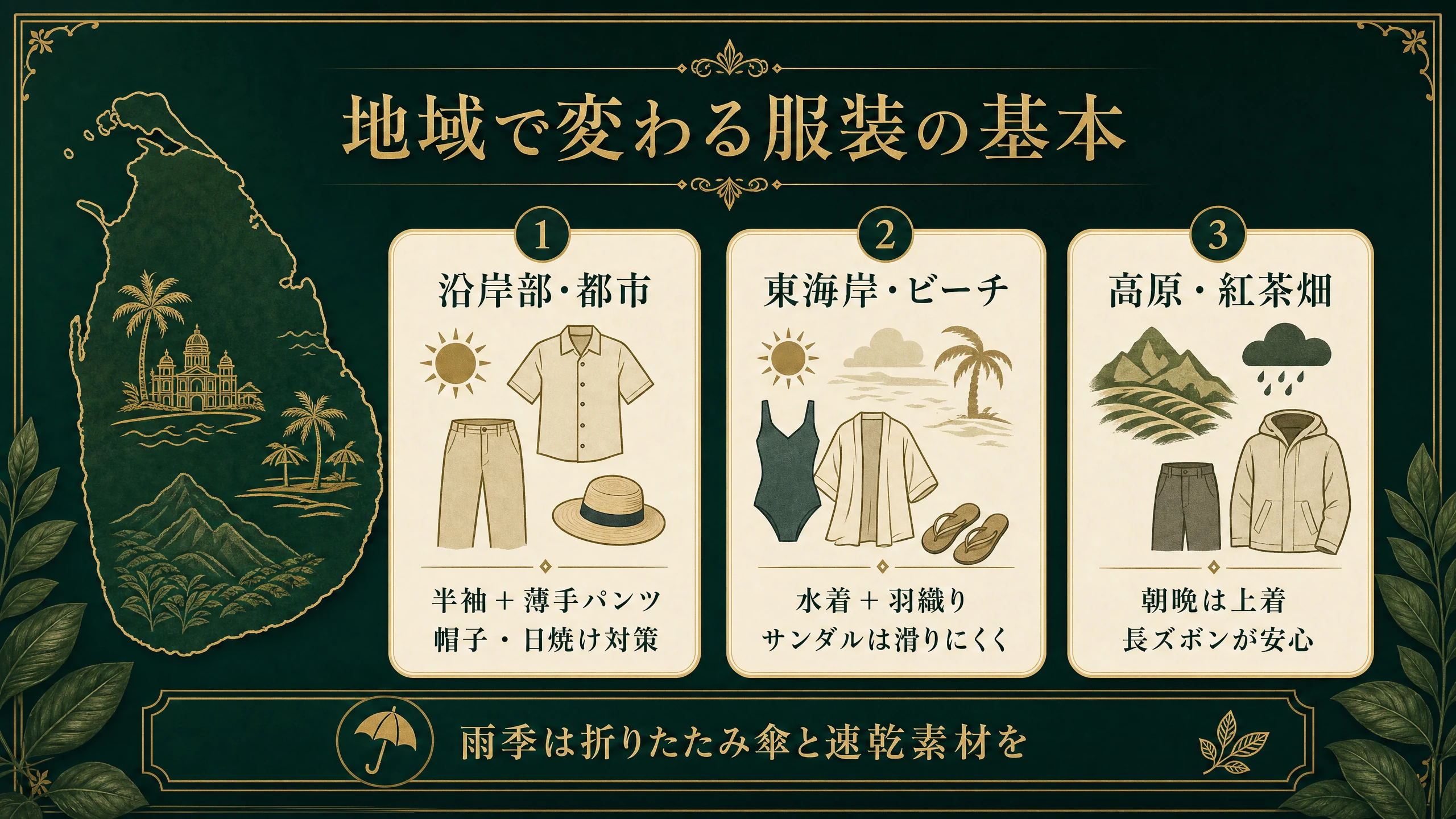
In the south-west (Colombo and Galle, along the western to southern coastline) The rainy season is from around May to September and around October to November.、The dry season is from December to March it is said.
Japan's best season is from winter to spring in the south-west.
In the North and East (such as Jaffna and Trincomalee) The rainy season runs from October to January、The dry season runs from May to September In contrast, the timing of the rainy season is reversed in the south-west.
The summer months are the peak season for the east coast resorts.
Regional climate variations
Temperatures do not vary greatly between regions (it's hot everywhere!), though the central highlands (plateau region) are a slight exception.

In high-altitude areas such as Kandy and Nuwara Eliya, temperatures may remain in the low 20s Celsius during the day and drop to the low 10s Celsius at night.
Even in the height of summer, the highlands may offer a coolness akin to Japan's spring or autumn.
Basic attire
In light of the above, everyday wear is Japanese summer clothing It's perfectly fine to use it in the same way.
both men and womenShort-sleeved T-shirt and lightweight long trousersAlternatively, shorts or skirts are perfectly acceptable as long as they are comfortable for movement.
The material is Cotton and linen Fabrics that absorb sweat and allow air to pass through are comfortable.polyester and nylonIt is advisable to avoid synthetic fibre garments, as they tend to become clammy with sweat.
Colour too Light colours such as white and pastels rather than dark colours like black The lighter colour reflects sunlight, making it cooler to be in.
★Quick Tip★
Even if you're fine in short sleeves and shorts during the day, you may find it surprisingly chilly indoors or when travelling. In Sri Lanka, air-conditioned hotels, buses and trains "The fridge!?" There may be times when it feels colder than expected... (Westerners tend to prefer stronger air conditioning). Also, activities in highland areas or during the early morning or late night (e.g., climbing the World Heritage site of Sri Padiva [Adam's Peak]) can be chilly, so it's wise to pack a light jacket (such as a cardigan or windbreaker) for peace of mind.
Differences in Clothing by Climate and Season (Comparison Table)
During my trip to Sri Lanka,The time of year to travelThe key points for preparing your clothing will vary slightly depending on the month. Particular care is needed in March and November, as the weather can be quite extreme.
The table below summarises seasonal characteristics and clothing/equipment considerations. Please refer to it according to the timing of your itinerary.
| Recommended travel period | Climate characteristics | Clothing and personal effects | Points to note |
|---|---|---|---|
| January to March Dry season / Best season ※Example: March |
Rainfall is at its lowest with a high percentage of sunny days. Weather remains relatively stable across the entire island. March in particular sees little rain throughout the territory, with days of intense heat occurring inland. | The basic attire is for midsummer. Breathable short-sleeved shirts and lightweight long trousers. Hats and sunglasses are essential. For inland areas and sightseeing at ruins, where the sun is strong, long-sleeved shirts are also useful. If heading to the highlands, bring a lightweight jacket. |
UV protection and heat precautions are paramount! Stay hydrated by drinking frequently and avoid prolonged outdoor exposure during the day. Whilst rainfall is infrequent, it is not entirely absent, so a folding umbrella is advisable for peace of mind. |
| April to June Southwestern monsoon rainy season ※Example: May |
The south-west enters its rainy season. Particularly in May and June, sudden squalls (intense evening downpours) occur frequently. It is hot, humid and muggy. The north and east enter their dry season around this time, with more sunny days. | Quick-drying fabrics are ideal (as they dry rapidly even when wet). Short sleeves and lightweight trousers suffice during the day. A folding umbrella or lightweight raincoat is essential for sudden downpours. Footwear: sandals that can get wet are recommended (preferably non-slip). | A foldable umbrella that fits in your bag is essential. Choose clothing that dries easily indoors. As mosquitoes become more prevalent in the southwest at this time, minimise skin exposure and remember insect repellent spray. |
| July to September Southwestern region: latter part of the rainy season & Eastern region: dry season ※Example: August |
Rain in the southwest may ease at times, but conditions remain unsettled. The east coast and north are experiencing clear skies at the peak of the dry season. Regional climate variations are significant. | Dress appropriately for the areas you'll be travelling to. If your itinerary includes the south and Colombo, keep rain gear handy but primarily wear summer clothing. For a trip centred on the east coast resorts, prioritise sun protection (short sleeves, shorts, and a rash guard, etc.). If you'll be visiting highland areas, don't forget a jacket. | In the southwest, continue to prepare for sudden heavy downpours. In the east, UV levels are at maximum, so apply sunscreen frequently. In both areas, the heat will be intense, so ensure you stay hydrated and replenish your salt levels. |
| October to December Northeast Monsoon Rainy Season, etc. ※Example: November |
Weather conditions are generally unsettled. The rainy season intensifies particularly in the north and east during October and November. Additionally, the southwest experiences frequent thunderstorms characteristic of a secondary rainy season. Even brief periods can see heavy downpours. | The basic approach is summer clothing plus full rain gear. Always carry an umbrella or rain jacket to prepare for sudden downpours. As the warm, humid rain makes you sweat quickly, opt for lightweight clothing and carry a change of clothes for best results. After dusk, switch to long sleeves and long trousers to ward off mosquitoes. | The peak season for mosquito breeding! Take thorough precautions against mosquitoes to prevent dengue fever. Wear non-slip shoes. By late December, the southwest transitions into the dry season, marking the arrival of the peak tourist season. |
※The above is merely a guideline. Please note that clothing requirements may vary depending on the area visited, even during the same period.
If you're wondering whether the city you're visiting is in the rainy season or dry season, it's reassuring to check the latest local weather conditions on a weather forecast site.
Essential Clothing and Items for Different Sightseeing Scenarios
There's a wide variety of activities to enjoy on a trip to Sri Lanka, isn't there?
Urban strolls, beach resorts, temple visits, safari experiences, highland tea plantation tours and Ayurveda treatments – each setting calls for its own ideal attire.
In this chapterDressing Advice for Different OccasionsLet's check it.
By skilfully adapting your attire to suit the occasion, you'll significantly reduce the risk of finding yourself in an awkward situation abroad.
City sightseeing and urban exploration
When strolling through cities such as the capital Colombo and Kandy,Casual clothing that is easy to move inThat's perfectly fine.
HoweverKeep exposure to a minimumThe key point is to dress appropriately. Even in the tropics, the locals tend to wear clothing that doesn't reveal too much skin.
Men tend to wear long trousers more often, while women also wear sleeveless tops and short bottoms less frequently.
Even if you're a tourist, wearing flashy outfits that show a lot of skin can make you the target of stares from those around you, or even crimes like pickpocketing or snatch theft...
Simple and clean-cut attireAvoid flaunting designer goods by carrying them ostentatiously.
both men and women Plain T-shirts with trousers or long skirts etc. are safe and comfortable choices.
When exploring the city on foot, footwear is also important. As there are unpaved, uneven paths,Comfortable walking shoesLet's go by [transportation].
Sneakers or sports sandals are less tiring to walk in for long periods.
While many people wear sandals in town, if you're taking a long-distance bus or train, Air-conditioning countermeasures It would be better if you had socks too.
✔防犯対策ワンポイント
In urban areasPickpocket preventionDo not forget. Keep valuables in a waist pouch (security pouch) that can be concealed under clothing, and make a habit of wearing backpacks or shoulder bags in front or keeping a hand on them at all times. While this isn't about clothing itself, it's essential not to let your guard down regarding safety.
Beach Resort Pool
To enjoy the blue sea and tropical beaches,swimsuitは必須ですね🏖️。
Many resort hotels in Sri Lanka feature swimming pools, so even those who do not swim A swimsuit is an essential item. is.
However, outside of hotels and tourist area beaches Walking around town in your swimsuit is not acceptable.。
Even at a resort, it is considered good manners to avoid revealing clothing at public beaches and their surroundings, which are also used by local residents.
Women wear a pareo or rash guard over their bikini, while men also wear a shirt,Cover up when leaving the beachLet us do so.
On the beach, shielding from the strong sunlight Wide-brimmed hats and sunglasses It's nice to have one. Sandals are also essential.
Beach sandals are handy to have as they're no bother when wet and easy to wash even when covered in sand!
On the seashore, the ground is scorching hot, so walking barefoot on the sand can feel like you might get burned...
Protect your feet with sandals or beach shoes.
✔水着に関するTIP
Whilst you can buy swimwear in larger towns in Sri Lanka, you're unlikely to find designs or sizes to your liking. If you're going to the trouble, it's best to prepare your favourite swimsuit back in Japan. Trying to buy one locally at the last minute might leave you with only unexpectedly local designs... as one Chinese traveller discovered. We recommend bringing a lovely, photogenic piece with you!
Visits to Temples and Religious Facilities
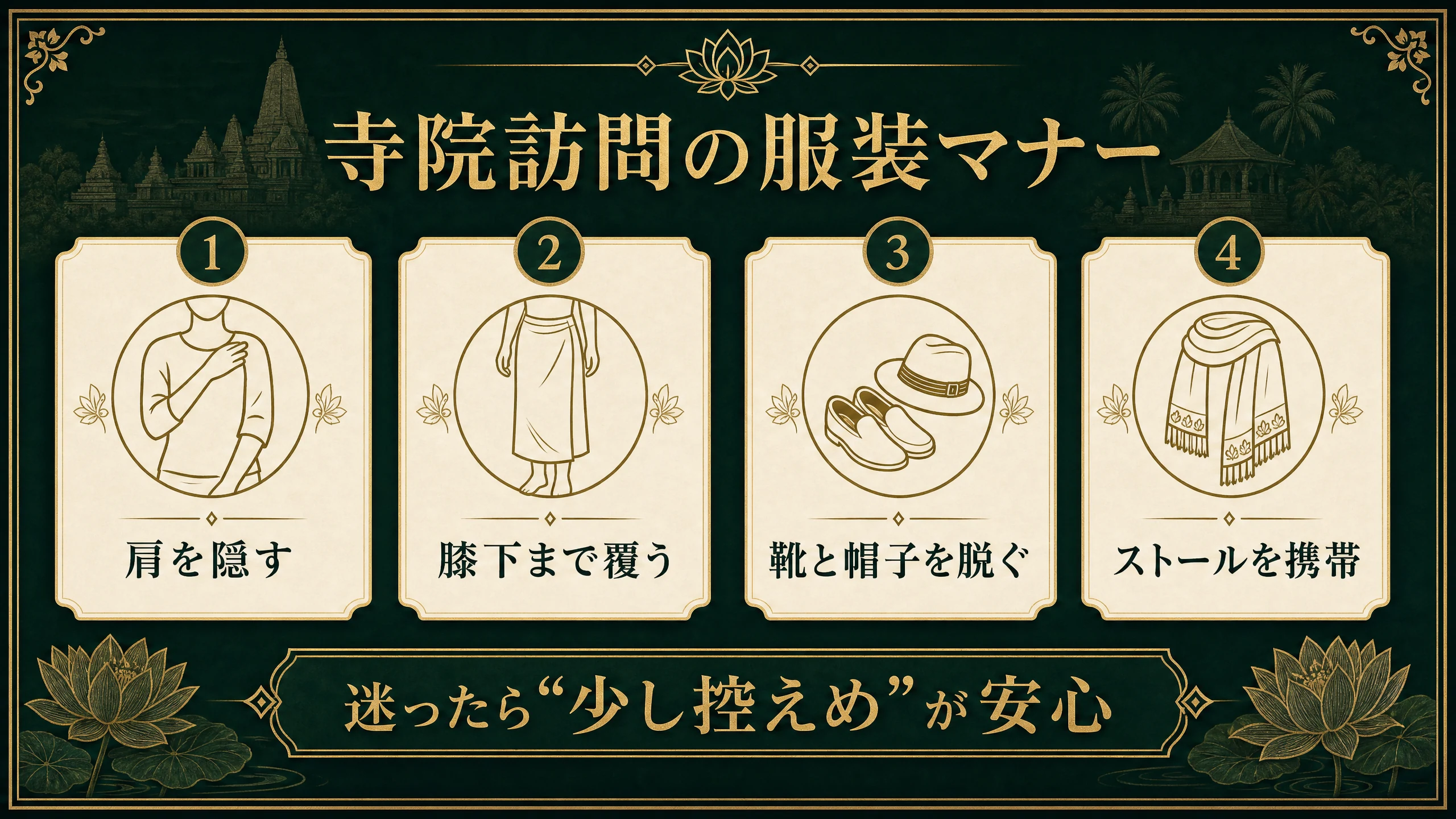
In the Buddhist nation of Sri Lanka, numerous temples (Buddhist temples) and sacred sites feature prominently on tourist itineraries.Dress code when visiting templesis extremely important!
Some tourists are turned away at the entrance without realising, so please ensure you adhere to the following.
Caution
- Exposing skin is strictly prohibited.:Clothes that cover the shoulders and kneesis the golden rule. Specifically,Short-sleeved tops (preferably with sleeves long enough to cover the elbows) plus long trousers are recommended. Women may also wear long skirts extending below the knee, provided the slit is not excessively high. Whilst shorts are not strictly prohibited for men, those shorter than knee length (around three-quarter length) may be subject to caution. Tank tops, camisoles, short shorts, and mini-skirts should absolutely be avoided.Please.
- Take off your shoesAt the temple entrance Shoes (footwear) must be removed. It is the rule. As you must generally go barefoot throughout the temple grounds, it is easier to take your shoes on and off. Sandals and slip-ons We recommend going on foot. Footwear must be left in the designated area at the entrance (a tip may be required).
- Measures against heat at your feetThe cobblestones and ground are often scorched by the sun, so walking barefoot can frequently result in an "Ouch!"The wearing of socks is permitted.Therefore, wearing thick socks protects your soles and makes it easier. While local worshippers, perhaps accustomed to it, walk briskly barefoot, travellers should not push themselves and make good use of socks.
- Pay attention to the colour of the clothesActually, in Sri LankaWearing white clothing when visiting templesThere is a custom [from the experience of a local travel agency staff member]. In Japan, the image is "temple = black mourning attire", but over there... White clothing = purity and respect Colours representing the region. Tourists wearing colourful patterns won't be scolded, but if possible White shirts and blousesWearing white helps you blend in with the local atmosphere (and it photographs beautifully). I remember feeling rather out of place in my black dress when I first visited a temple in Sri Lanka... If you're going to make the effort, why not wear white to match the mood?
If Clothing that contravenes the dress code Even if you happen to go in that way, rest assured. At many temples, at the entrance Loanable cloth (sarong = waist wrap or stole) We have prepared.
For a tip of a few hundred rupees or a small fee, they will lend you something to cover your shoulders and legs, allowing you entry.
However, it will result in a loss of time and money, so it is better to do it yourself from the outset. Lightweight cardigans and oversized stoles It would be wise to bring it along so you can slip it on quickly.
Safari and Wildlife Tours
As a unique pleasure of Sri Lanka National Park Safari(Jeep safari) is available.

Yala National Park and Udawalawe National Park are popular destinations. Key points for clothing when going on a safari are as follows:
Memo
- Long sleeves and long trousers recommendedFor protection against sunlight and insects, if possible Lightweight long-sleeved shirt and long trousers Wear appropriate clothing. As we'll be travelling in an open-top jeep, you'll be exposed to direct sunlight during the day, and mosquitoes and small insects are present in the jungle. Covering your skin is advisable. If it gets too warm, you can roll up your shirt sleeves or adjust zip-off trousers for comfort.
- Clothes that can get dirtyOn safari, the dust really kicks up! While driving, dust from the vehicle ahead relentlessly rains down on you, and after the tour, you might find yourself covered in a light layer of brown... Avoid wearing designer clothes; opt for casual outfits you won't mind getting dirty.masks and bandanasCovering your nose and mouth will help protect against dust.
- Colours are earth tonesThis is not essential, but to avoid causing unnecessary distress to the animal.Colours that are not too flashyだとベターです。ベージュ・カーキ・オリーブなどいわゆるサファリルックな色合いだと気分も盛り上がります🐘(ただし観光客向けサファリでは車から降りないので、そこまで神経質にならなくても大丈夫です)。
- Early mornings and evenings are chilly.Safaris are when animal activity is most vigorous. early morning or evening It is often carried out during these times. As it feels quite cool when the sun is not out,Lightweight windbreakerPlease bring a parka. The open jeep gets quite windy and cold while driving.
- Hats & SunglassesFor daytime safaris, the blazing sun makes these essentials. Particularly for hats, opt for ones with chin straps or that sit low on the head to prevent them blowing off.
Shoes trainers We recommend this. While you generally won't need to get out of the jeep and walk, you may need to step out occasionally for boarding/alighting or at viewing spots where the footing can be somewhat uneven.
Footwear that covers the toes and allows ease of movement provides peace of mind (sandals may come off while running).
As they will get dirty with dust, it would be advisable to wear shoes that can be washed after returning home.
Central Highlands · Tea Hill Tour
high altitude Central Highlands Area (e.g. Nuwara Eliya, Ella, around Kandy) If you're going there, you'll need to prepare different clothing than you would for flat terrain.
During the day, you can manage in short sleeves, but mornings and evenings are chilly. long-sleeved jacket Essential. Do take a light jumper or hoodie with you.
Nuwara Eliya, in particular, is a summer retreat known as 'Little England', where temperatures drop to the low 10s Celsius at night, making it rather chilly.
Moreover, the weather in the highlands is changeable. Sudden drizzle It may rain occasionally. If it's only a light drizzle, we'll carry on with our activities without much concern.Clothing suitable for light rainis ideal.
For instance, carry a water-repellent parka or a folding umbrella, and wear quick-drying synthetic shirts that dry promptly even when wet.
Shoes trainers It's better to wear shoes with non-slip soles, as there are many opportunities to walk through natural settings such as tea plantations and viewpoints along the World Heritage-listed Highland Railway.
As the ground can become muddy in the rain, it's safer to wear shoes that can get dirty rather than your favourite white ones.
✔豆知識
When undertaking forest trekking during the rainy season (such as in the Sinharaja Forest)Countermeasures against leechesBear in mind that leeches are small parasitic worms, much like bush mosquitoes, found in woodlands where they attach themselves to skin to feed on blood. Covering your legs with long socks or gaiters and spraying boots or ankles with commercially available leech repellent or salt water provides considerable protection. While you are unlikely to encounter them during ordinary sightseeing, those planning to participate in nature-based activities should take care.
Ayurvedic treatment

When it comes to Sri Lanka Ayurveda Some of you may be looking forward to the experience.
When receiving traditional medical treatments such as oil massage or shirodhara, the spa may provide treatment attire, but it is advisable to bring your own for peace of mind.
Points
- Clothes that can get dirtyAfter the treatment, your skin will be shiny with oil. Although you can wash it off in the shower, some oil may remain in your hair or on your body. It's fine if the oil stays on. Comfortable T-shirts and loungewear Please bring it with you. Avoid white clothing or delicate fabrics; dark-coloured, loose-fitting garments will conceal any oil stains should they occur.
- Clothes that are easy to put on and take offPrior to and after massage, ease of changing is paramount. We recommend loose-fitting dresses with minimal buttons or fastenings, or elasticated-waist trousers – attire that allows for smooth removal. For female clients, disposable paper shorts or bras may be provided during treatment, so clothing that can be swiftly removed is advisable.
- Post-treatment warmth retentionAfter relaxing with an oil massage, you may find your body feeling warm and slightly sweaty. As treatment rooms and rest areas are often not air-conditioned, please take care not to catch a chill when stepping outside. Lightweight haori It would be wise to have one ready.
At upmarket spas locally, bathrobes or dedicated attire may be provided, though at simpler establishments, you may need to bring your own change of clothes.
If you're concerned, it's a good idea to check when making your booking or look at the reviews.
What to Wear on a Trip to Sri Lanka [Women's Edition]
Next up isFor womenHere are some clothing tips. From a female traveller's perspective, I've compiled items I'm glad I packed and points to bear in mind.
Modest exposure is the rule
To reiterate, Sri Lanka has a relatively conservative culture regarding women's attire.
Walking around town in outfits that bare the shoulders, navel, or thighs will likely draw unwanted attention, and also increases the risk of crime.
especially Young women travelling alone Therefore, avoid revealing clothing and take precautions such as carrying a personal alarm and travelling with companions.
Local Chinese EmbassyIt also advises women to avoid wearing revealing clothing and to refrain from travelling alone at night.
That said, there's no need to cover yourself entirely in long sleeves and long trousers.
Short-sleeved shirt + three-quarter length trousers や A dress that covers the knees Rest assured, you'll be perfectly fine wearing items that reveal just a little skin.
Adjust with a wrap or stole
The versatile item I'd recommend for women is Large-sized stole (lightweight shawl)!

It's invaluable for sun protection, combating air conditioning, and quickly covering up exposed skin. It can also be used to cover your head and shoulders in temples, and makes an excellent substitute for an in-flight blanket.
Do pop one in your bag. A lightweight cardigan is also handy to have for easy layering.
Cool and comfortable clothing
The classic choice for female travellers Dresses and maxi skirtsThe long skirt swaying in the southern breeze looks absolutely stunning in photographs, and it's wonderfully airy and comfortable.

However, as ankle-length styles can be prone to catching on stairs, opt for a design that allows for easy foot movement.
For those who prefer knickers Loose-fitting linen trousers や gaucho trousers It's cool and recommended.
ピタピタのスキニージーンズは汗で貼り付くと地獄なので避けたほうがいいかも…(オシャレしたい気持ちは分かりますが💦)。
Functional underwear
When it's hot, even your underwear gets soaked through with sweat. Women especially. Quick-drying, moisture-wicking bra top や Seamless briefs Even when you sweat, it causes less discomfort and is easy to wash.
When travelling, there may be occasions when you need to wash underwear and socks in your hotel room,Quick-drying fabricHaving a few of these on hand makes rotation easier.
Additionally, if travelling during your period, it is advisable to bring sanitary products from Japan (though they can be purchased locally, many people feel more comfortable using Japanese brands).
When do you want to dress smart?
Resort dinners or bars in luxury hotels, for instance, dressing up There are times when you want to, aren't there?
For such occasions smart dress It's very useful to take one with you.
Shoulder-covering designs with an elegant style can be worn with confidence outside temples and photograph beautifully.
Buying a lovely sari (traditional dress) locally and having it fitted for you makes for a wonderful travel memory.
Some shops will make you a simple blouse if you purchase the fabric there.
普段着には難しくても、特別な撮影用にチャレンジしてみるのもアリです📷✨。
Clothing for Travel in Sri Lanka [Men's Edition]
NextFor menKey points for your attire.
Essentially, Japanese summer attire plus a little extra will suffice, but let's also confirm some points specific to men.
T-shirt and shorts are the basic outfit.
During sightseeing Short-sleeved T-shirt and shorts Casual attire is perfectly acceptable. As it's a hot country, many male tourists wear shorts even in town.
However, shorts that are too short (such as running shorts with a length of 10cm or more above the knee) are not permitted for entry into temples, soknee-lengthLet's choose the one.
Local men tend not to wear shorts very often.
Most wear long trousers or the traditional sarong, a wrap-around skirt, but it is not considered rude for foreigners to walk around in knee-length shorts.
Long trousers and collared shirts are also available.
Gentlemen, please Long trousers (lightweight chinos or linen slacks, etc.) one bottle,Collared shirts (such as polo shirts or casual button-down shirts) Please take one or two with you.
There are two reasons.
(1)Temple countermeasuresLong trousers that cover the knees will ensure you can enter any temple without issue, and a short-sleeved polo shirt will give a respectable impression even to the locals.
(2)Dress code measuresAt high-end hotel restaurants and bars, men wearing tank tops, shorts and flip-flops may be refused entry.
Even at a tropical resort, ensure you're prepared to dress smart-casual with a collared shirt, long trousers and smart shoes to avoid looking out of place.
Indeed, there are tales of travellers wearing shorts being made to don a sarong before being allowed entry at Colombo's famous hotels...
Do bring clothing appropriate for the occasion, rather than just T-shirts and shorts.
Points
- Quick-dry shirts are convenientMen do tend to sweat a lot, don't they...Inner shirt made from dry materialWearing a quick-drying T-shirt from a sports brand as underwear keeps you feeling fresh and comfortable even when you sweat. Available at outdoor shops. Moisture Control Underwear These are also worth considering. As they dry quickly after washing, rotating two or three during your trip will keep you fresh throughout.
- Local business supportIf you have business purposes such as a business trip or on-site negotiations,A full suitConsider bringing your own or renting locally. Although a developing country, Sri Lanka may require Western-style suits for formal occasions. As your appearance can significantly influence others' perceptions, it is advisable to have at least a jacket and tie ready (though a no-tie culture exists due to the heat, it is prudent to be prepared).
✔ローカルスタイルも楽しもう
We highly recommend that male travellers also try on the local traditional attire. 「Salon (Sarong)」 It's a single-piece waist wrap for men, worn like a wrap skirt – wonderfully cool! Many people wear it for relaxing at home, and you can find them cheaply at markets. Even tourists might look like a local if they wrap a sarong around their waist at the beach. It's not just clothing; it's a large piece of fabric with many uses, so buying one as a souvenir could be quite interesting.
Clothing Selection Q&A: Common Questions Compiled
Finally, we'll review some common questions from Japanese travellers about what to wear on a trip to Sri Lanka in a Q&A format.
Q. I heard you can wear summer clothes all year round in Sri Lanka – is that true?
A. Generally speaking, YES! It's warm enough to wear short sleeves and shorts throughout the day, year-round. However, do pack one lightweight long-sleeved top and one pair of long trousers for air-conditioned spaces and visits to highland areas or temples.
Q. To what extent should women cover their skin?
A. For everyday sightseeing, it is sufficient to cover your shoulders and knees. Even with sleeveless tops or shorts, you can comply by covering up with a cardigan or shawl. Rules are stricter at temples, so please observe the above guidelines at least when entering.
Q. Which is better, sandals or shoes?
A. Having both is handy! For active days, opt for trainers; for hot city strolls or temple visits, choose sandals that are easy to slip on and off. Flat shoes or beach sandals will also prove useful around the hotel or on the beach.
Q. Is it acceptable to buy clothes locally?
A. Absolutely fine. Markets in Colombo and elsewhere offer inexpensive T-shirts and trousers, while local garments like saris and sarongs are popular souvenirs. However, as sizes and quality vary considerably, it's advisable to bring some familiar clothing from Japan to balance things out.
Q. Which is better for rainy weather: an umbrella or a raincoat?
A. I'm troubled, but... Personally, folding umbrella I recommend it. For sudden downpours, an umbrella is quick and easy to open, and in muggy weather, ponchos or coats can actually feel too warm. However, you can't use an umbrella while travelling by motorbike taxi (tuk-tuk), so keeping a simple rain poncho tucked away makes it perfect!
Summary: Key points to note regarding clothing in Sri Lanka
To summarise the key points of this session:
- A tropical country that is hot all year roundTherefore, your basic attire should be suited to Japan's midsummer conditions! Opt for lightweight, breathable clothing to prepare for direct sunlight and high humidity. For highland areas and air-conditioning precautions:Light jacketDon't forget.
- Rainfall varies by season and regionTake particular care. During the dry season (e.g. March), ensure thorough protection against sunburn and heatstroke; during the rainy season (e.g. November), carry a folding umbrella and wear quick-drying clothing.Sudden downpourPlease take appropriate measures. During the monsoon season, mosquitoes proliferate significantly, so ensure you use extra repellent!
- Strict observance of dress code is required at religious facilities such as temples.:both men and womenCover your shoulders and kneesAppropriate attire is essential. Women should wear long skirts and short-sleeved blouses, while men are also requested to wear long trousers. If possible,white-coloured clothingThis matches local customs. At temples, one removes one's shoes.Sandals + thick socksTo combat the heat at your feet.
- Key points for women's attireOpt for modest coverage and prioritise ease of movement. Use stoles or cardigans to regulate temperature and manage skin exposure, while still enjoying tropical chic in your favourite dress. For safety, avoid overly flashy outfits at night or in less populated areas.
- Key points for men's attireDuring the day, T-shirts and shorts are comfortable. Additionally,collared shirt and long trousersalso prepared, for temple visits and high-end shopsPropernessIt's reassuring to have everything ready to go. Enjoy your tropical getaway with both lightness and a sense of cleanliness.
- Essential items for different situationsAt the beachswimsuit+Outerwear, in the safarilong-sleeved garments+Hat & shoes that can get dirty, in the highlandswinter clothing+Rain gear, in AyurvedaEasy changing…and prepare accordingly for the itinerary. Wearing appropriate footwear—trainers, sandals, or beach sandals—will ensure comfort.
服装準備を万全にしておけば、スリランカの旅は怖いものなしです!🌴✨
Dressing in a manner suited to the local culture will undoubtedly make interacting with locals much smoother, and you yourself will be able to relax more and enjoy your travels.
さあ、しっかり準備を整えて「輝く島」スリランカへ思い切り飛び出しましょう。良い旅を!🌟