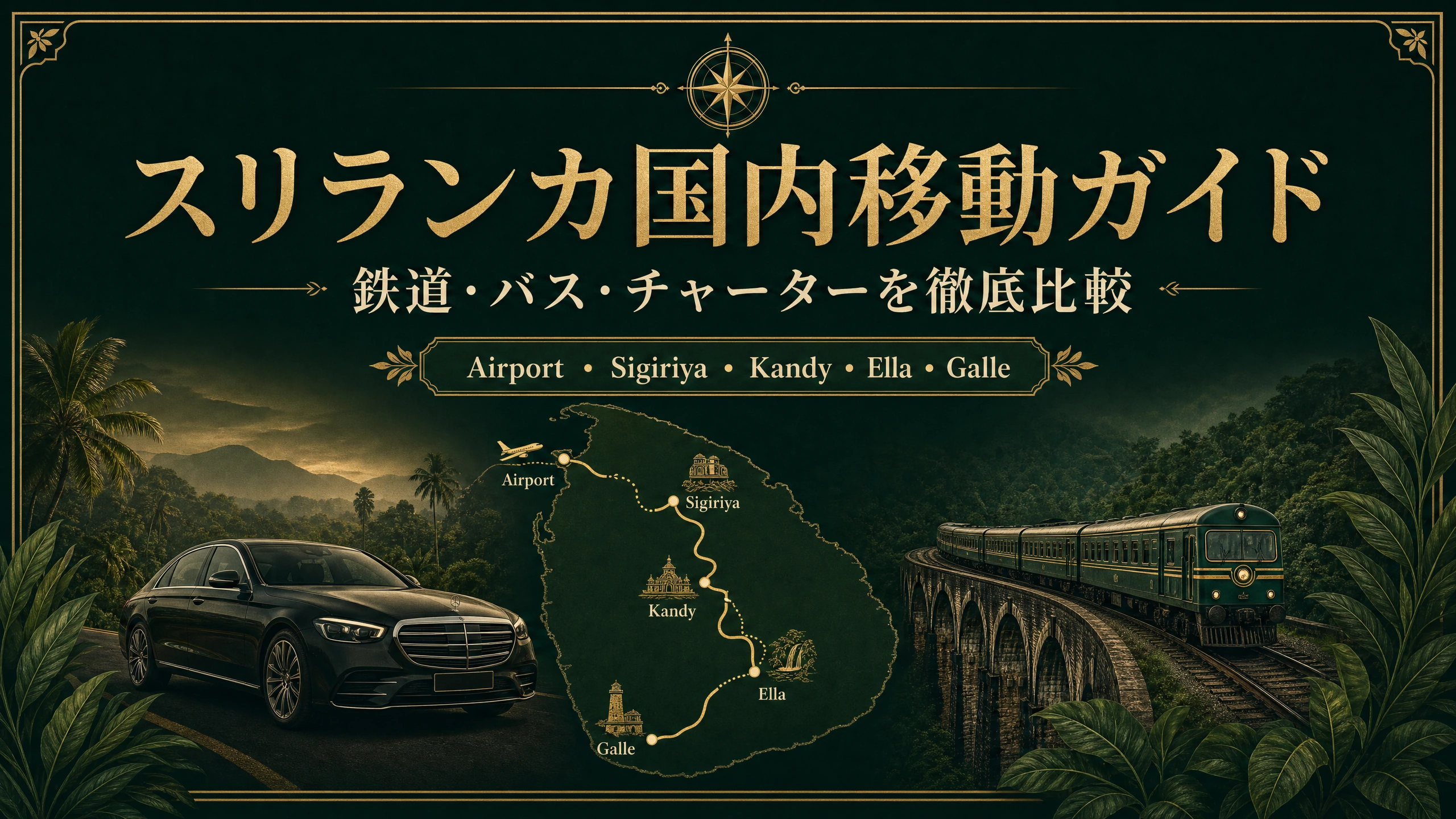
Are you feeling anxious about local transport during your trip to Sri Lanka?
When visiting a country for the first time, there's so much you don't know—how to use trains and buses, the fares, and the safety of travelling, isn't there?
In fact, Sri Lanka offers a wide variety of transport options, including railways, buses, tuk-tuks, and chartered taxis.
This article provides a comprehensive explanation of the advantages and disadvantages of each, along with tips on how to use them.
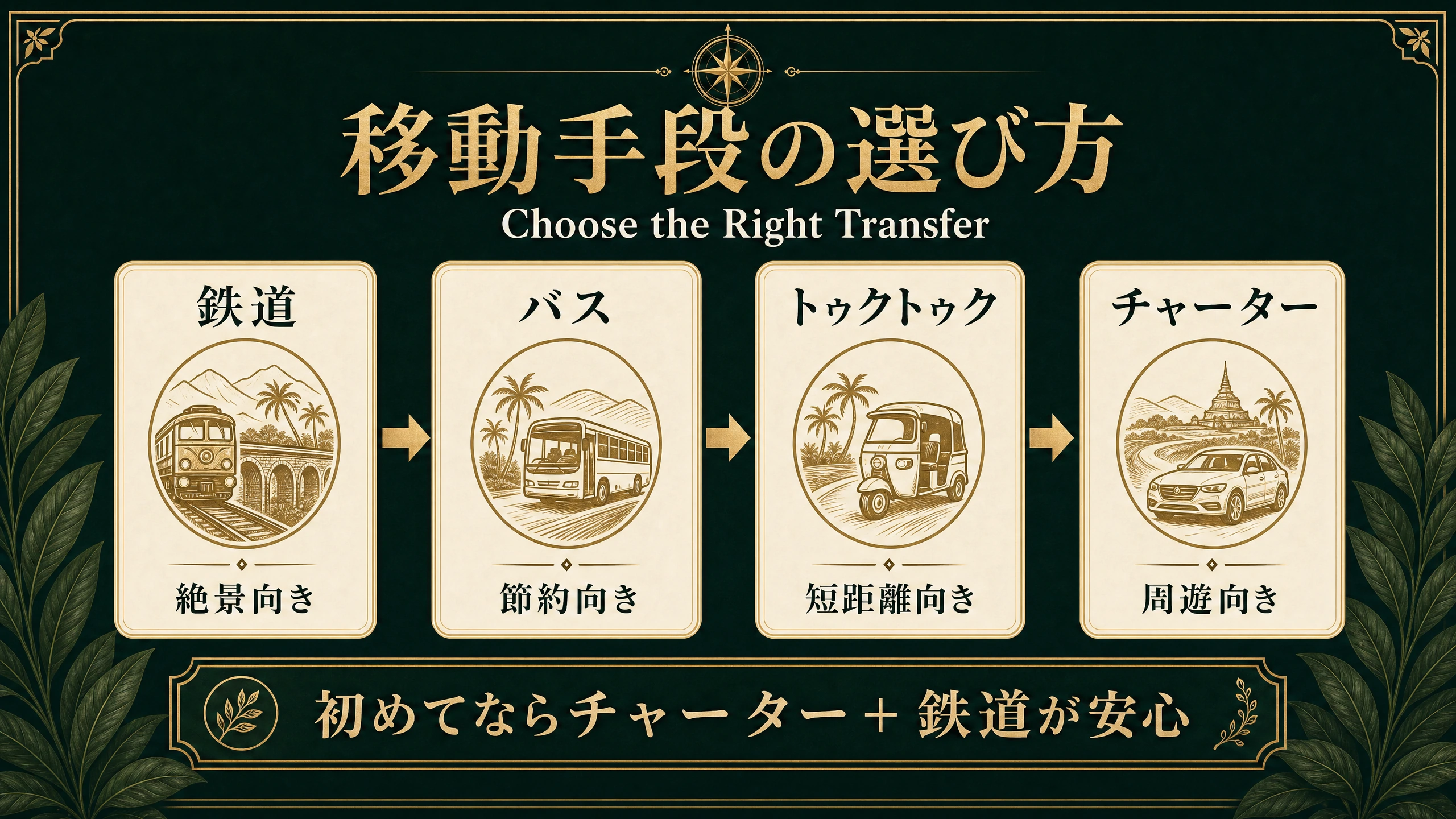
First, the table below lists the advantages and disadvantages of each mode of transport.
| means of transport | Advantages | Disadvantages |
|---|---|---|
| Taxi charter (in reality, the most common) |
✅ Flexible scheduling and time management for outstanding efficiency ✅ Private car for safety, comfort and peace of mind regarding luggage ✅ Japanese support companies are also available for beginners |
✅ More expensive than other methods ✅ Reliability checks essential when selecting a driver |
| railway | ✅ Extremely low fares (even long distances cost only a few hundred yen) ✅ Numerous scenic routes allow you to enjoy sightseeing while travelling ✅ First and second class offer relatively comfortable reserved seating. |
Delays are a daily occurrence, making it impossible to predict when things will happen. ✅ Third class is extremely crowded & the seats are hard, making long journeys tiring. ✅ There is a risk of pickpocketing and bag snatching. |
| Express Coach (AC) | ✅ With air conditioning and a seat, it's relatively comfortable. ✅ Frequent services with high frequency between major cities ✅In some cases, it is slightly faster than the railway. |
✅ Drives recklessly and is prone to motion sickness ✅ When fully booked, passengers may have to stand or wait for the next service; departures are often delayed. |
| Local bus (regular) | ✅ The cheapest way to get around with the most extensive network ✅ Local experiences available ✅ High flexibility for boarding and alighting with excellent manoeuvrability |
✅ Always packed to the rafters & no air conditioning as standard ✅ Poor driving manners and safety concerns ✅ Departure times are unpredictable depending on passengers |
| tuk-tuk | ✅ The ultimate mobility for short-distance journeys around town ✅ Affordable first ride for easy access ✅Fare display is also possible via the ride-hailing app |
✅ You may be charged exorbitant fees ✅ Not suitable for long distances or heavy luggage ✅ Prone to exposure to exhaust fumes, noise, and wind and rain |
| Taxi (Uber/PickMe) | ✅ Peace of mind with app-based fare confirmation and transaction records ✅ Air-conditioned and equipped with seat belts for your comfort ✅ No problem even with lots of luggage |
✅Rides may not be available in some suburban areas ✅ More expensive than public transport; significantly affected by congestion during rush hour |
| Domestic flight (seaplane) | ✅ Significantly reduce long-distance travel time (30 minutes to 1 hour) ✅ Enjoy breathtaking views through the “sky window” rather than the train window |
✅ Higher fares (50–150 USD) ✅ Prone to delays and cancellations due to adverse weather conditions ✅ Destinations are limited |
| Bicycle hire | ✅ Explore World Heritage sites and other attractions at your leisure ✅ Just a few hundred yen a day – incredibly cheap & perfect for combating a lack of exercise |
✅ Exhausting physical exertion due to intense heat and squalls ✅ Self-management is required to prevent theft |
| Bike hire | ✅ Maximum freedom on mountain roads ✅ Can handle country roads ✅ Rental fees are also reasonably priced at approximately 5 to 10 USD per day. |
✅Chaotic traffic rules ✅ High accident risk; insurance, helmets, etc. are your own responsibility |
| Rental car (self-drive) | ✅ Complete freedom to take any route you like | ✅ International driving licence + local permit required ✅ Road conditions are poor and driving is difficult ✅ Response to accidents is your own responsibility |
We'll also include tips for enjoying your travels safely, so by the time you finish reading, any concerns you may have about getting around within Sri Lanka should be well and truly resolved.
Right then, let's get started by looking at the basics of travelling within Sri Lanka!
- Essentials of Travel within Sri Lanka: Size and Transport Conditions
- Travelling by rail (train)
- The option is to use the railway for the tea train section and a chartered taxi for the rest.
- Travelling by bus (long-distance coach, local bus)
- Using a tuk-tuk (three-wheeled taxi)
- (Top choice) Utilise a chartered taxi
- Other modes of transport: domestic flights, bicycle hire, etc.
- Travel within Sri Lanka is safe and comfortable by chartered taxi.
Essentials of Travel within Sri Lanka: Size and Transport Conditions
Sri Lanka is a surprisingly large country, with an area approximately 0.8 times that of Japan's Hokkaido, and its major tourist destinations are scattered across the island.
The rail and bus public transport network covers almost the entire country, and with a little ingenuity, you can travel around efficiently.
However, road conditions and the environment for using public transport differ significantly from Japan.
For example, it is not uncommon for trains or buses to arrive late or take a significantly longer route.
The Japanese Ministry of Foreign Affairs has also issued a warning, advising travellers to "ensure safe means of transport when moving within Sri Lanka".
The US State Department also advises against using local public buses for safety reasons.
First, familiarise yourself with Sri Lanka's unique traffic conditions and aim to plan your itinerary with ample time built in.
Now, let us examine the characteristics and usage of each specific mode of transport.
Travelling by rail (train)
Sri Lanka's railwayswas constructed during the 19th-century British colonial era and continues to connect major cities and tourist destinations.
The pace of travel is not swift, but its charm lies in allowing one to savour the leisurely atmosphere of the journey.
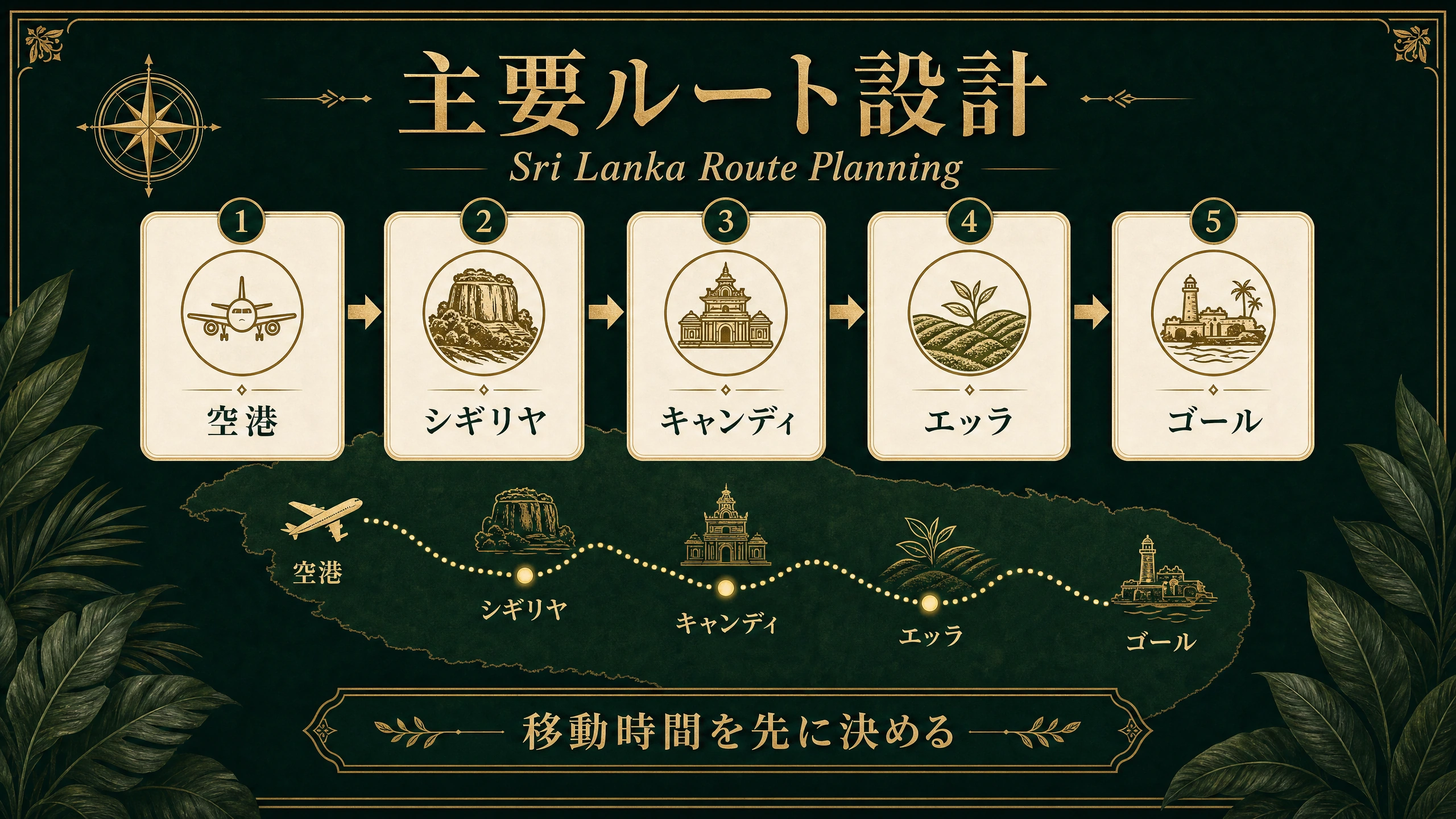
The mountain railway between Kandy and Ella, in particular, is one of South Asia's most spectacular routes, hailed as offering 'the world's most beautiful train journey'. The train ride, with views of tea plantations, valleys and the Nine Arch Bridge, is immensely popular with tourists.
The coastal route from Colombo to Galle also offers refreshing views overlooking the Indian Ocean, making it well worth seeing.
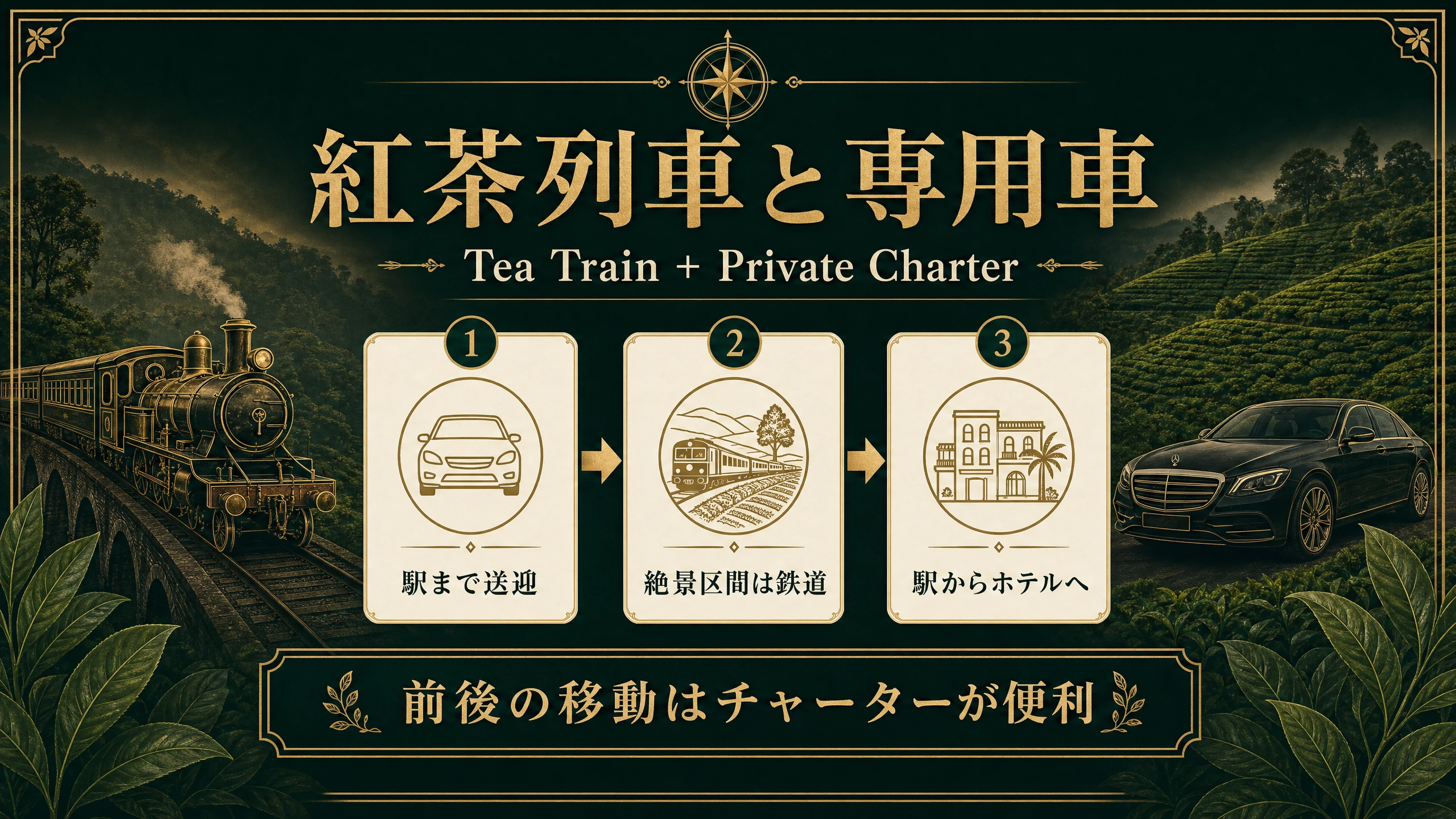
Incidentally, by using the taxi charter service mentioned later, it is possible to arrange to travel this section by rail.
You can be driven to your boarding station, have your ticket purchased for you, and be picked up at your destination station in advance.
The taxi charter service utilised by the author is Sri Lanka Taxi Charter Sea Service.
Indeed, whilst I utilised chartered taxis throughout the journey, I took the train between Kandy and Ella.
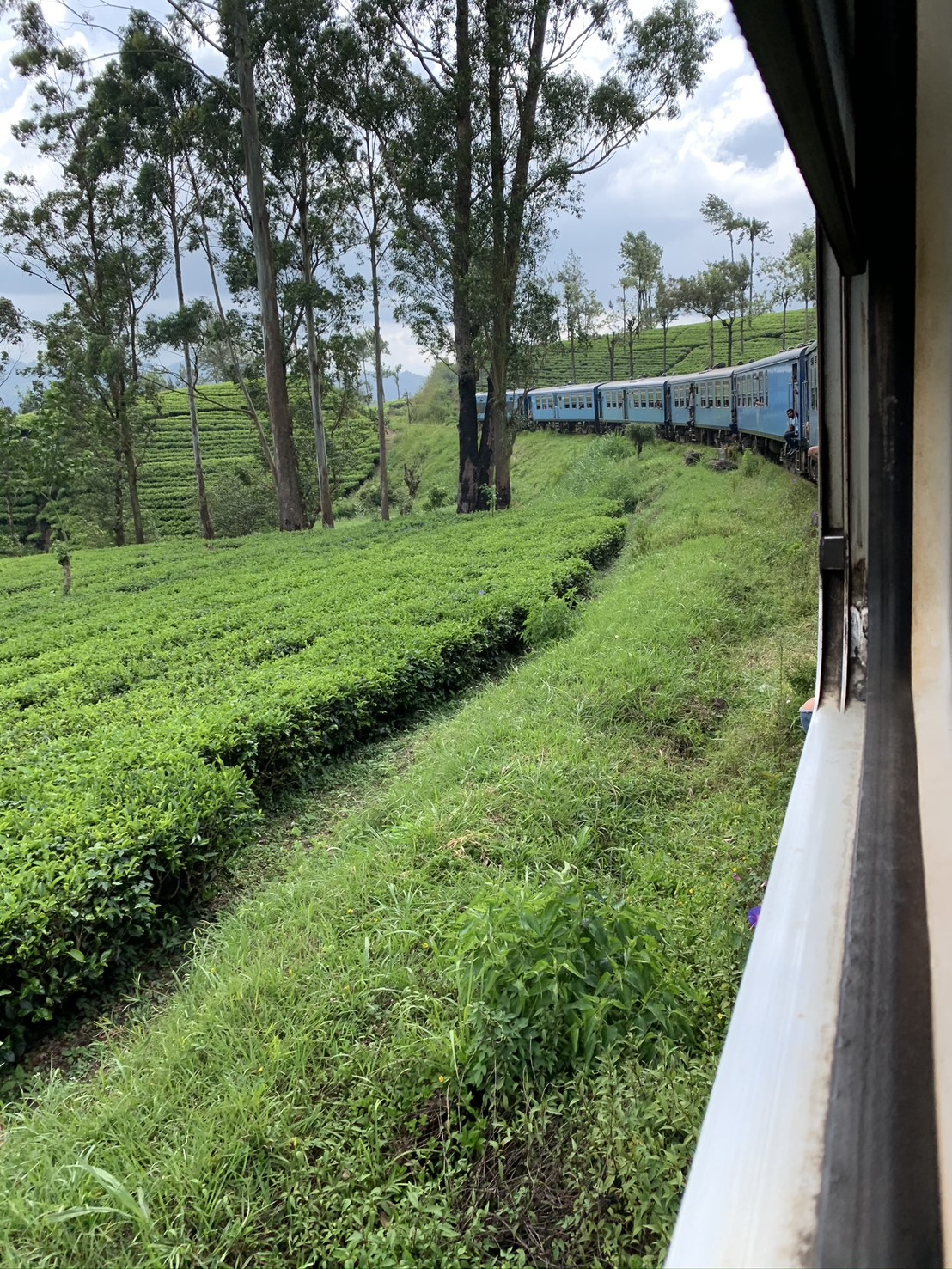
The scenery from the train window was truly beautiful.
low costThe railway is also a major attraction. Even for long distances, fares are remarkably cheap, costing only a few hundred yen. For example, the journey from Colombo to Kandy (approximately 120km) costs around 180 rupees (approximately 80 to 90 yen) in third class, and even in first class, it costs only about 500 rupees (approximately 250 yen).
Major trains feature seating classes ranging from First Class to Third Class, with First Class comprising fully reserved seats with air conditioning, including observation cars and sleeping cars.
Some second-class trains are available for reservation and offer slightly more spacious seating, whereas third-class consists primarily of unreserved wooden bench seating and is extremely crowded with commuters.
Travelling long distances in third class requires considerable stamina, so if you seek comfort, it is advisable to book a reserved seat in first or second class well in advance.
Reservations can be made at ticket offices in major stations from 30 days prior to travel, as well as via the Sri Lanka Railways official website, telephone booking, and more recently through online booking services such as 12Go.
When boarding, after purchasing your ticket, pass through the ticket gates and check the platform information display to confirm the train's destination and departure platform.
At smaller local stations, information may be displayed on signs rather than electronic boards. Many trains do not run on time, and delays are commonplace, particularly when boarding from intermediate stations.
First class offers the reassurance of reserved seating, but in second and third class non-reserved carriages, the scramble for seats can be intense. If you have large luggage, you may find yourself struggling as people spill out onto the deck and into the aisles.
As platforms may change at the last minute, it is advisable to ask station staff or fellow passengers, "Is this train bound for [destination]?" if you are unsure.
The greatest advantage of train travel is undoubtedly the beautiful scenery and the sense of adventure.
The sight of tea fields stretching out within arm's reach from the window, and the leisurely moments spent sipping tea in the gently swaying carriage, will surely become memories that transcend mere travel.
The following are photographs I actually took myself. Truly breathtaking countryside scenery, isn't it?
Another appealing feature is the extremely low fares, allowing you to travel long distances without worrying about the cost. On the other hand, the disadvantages are the lengthy journey times and the lack of punctuality in the timetable.
For exampleColombo–KandyThe journey takes approximately three hours by bus, but by train it can take 2.5 to 3 hours even on an express service, and over four hours on a local train. Sri Lankan railways are often derided as being "as slow as a snail", particularly in mountainous sections where trains crawl along at a snail's pace. This requires careful planning if your itinerary is tight.
In addition to delays, there have been reports of pickpocketing incidents on board, so please take care with your large luggage and valuables.
Overall, rail travel can be described as a mode of transport that prioritises experience over efficiency. By making the most of it on sections offering spectacular views, while also incorporating other means for journeys with tight schedules and factoring in the risk of delays during planning, you are sure to enjoy an unforgettable rail journey.
The option is to use the railway for the tea train section and a chartered taxi for the rest.
Many people, I imagine, come with the specific aim of seeing the scenery of Sri Lanka's tea plantations.
The section from Candy to Nanu Oya, or to Ella, is particularly renowned as the Tea Train route.
For those wishing to enjoy the tea train on this section whilst efficiently covering the rest, we recommend chartering a taxi.
After travelling by chartered taxi from the airport to the Cultural Triangle for sightseeing, we shall enjoy the journey on the Tea Train from Kandy to Nuwara Eliya.
The standard itinerary involves being picked up again in Nuwara Eliya, then visiting the World Heritage site of Galle in the south before returning to Colombo.

Additionally, some taxi drivers may be able to arrange reservations for the Tea Train using their local connections.
Even if you can't make a reservation, they'll assist you in purchasing tickets locally, making them a reliable ally.
Combining the best of rail travel and chartered taxi services can be quite enjoyable. Recommended chartered taxi companies are listed below.

Travelling by bus (long-distance coach, local bus)
Sri Lankan busIt is the primary mode of transport for local residents' daily commutes, boasting the nation's most extensive route network and highest frequency of services.
Routes criss-cross nearly the entire island, from the capital Colombo and the ancient city of Kandy, to the point where it is said there is nowhere you cannot go. Express buses also run frequently between major cities, with services departing constantly from early morning until evening on routes such as Colombo–Kandy and Colombo–Galle.
The fares are surprisingly cheapFor short distances, fares range from 20 to 50 rupees (approximately 10 to 30 yen), while even longer journeys costing around 200 to 300 yen for several hours' travel remain remarkably inexpensive. For instance, a standard bus between Colombo and Kandy costs roughly 150 to 300 rupees (about 75 to 150 yen), while an air-conditioned express bus costs around 1,000 rupees (approximately 500 yen).
Tickets are generally paid for after boarding, by informing the conductor of your destination. As many local buses depart once full, passengers may face lengthy waits at terminals until enough passengers gather (during off-peak hours or on rural routes, departures may be delayed by over an hour...). Take care if travelling to a time-sensitive destination.
As a tip for taking the bus, you first need to find the terminal or bus stop from which the bus bound for your destination departs.
In some cities, there are multiple long-distance bus terminals, with departure and arrival points separated by destination, so it is necessary to check locally.
If you're unsure, simply ask those around you in English and they'll kindly assist you. Once aboard, an attendant will come round to collect fares, so take your payment ticket at that time.
Large luggage can be placed in the luggage compartment, though a luggage fee may be charged. Please retain your ticket until you disembark.
Moreover, many buses operate in a local style where, provided you are along the roadside, they will pick you up even outside designated stops if you raise your hand.
Signalling to a moving bus will prompt it to slow down and pick you up, though it often employs the rather daring tactic of allowing passengers to board or alight without coming to a complete halt. Consequently, one might witness scenes of people practically leaping aboard as the bus moves, or even jumping off while it's still running. While it's unwise to push your luck, such experiences could well be considered part of the 'thrill of travel'.
by busThe greatest advantage is undoubtedly the low fares and extensive route network, meaning you can travel cheaply almost anywhere.
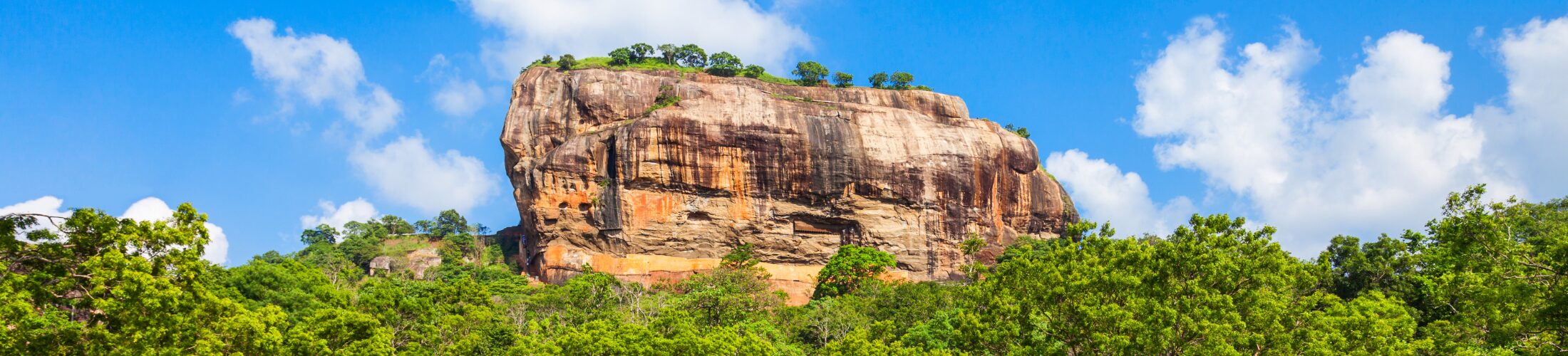
Bus services also provide access to World Heritage sites without rail connections (such as Sigiriya and Anuradhapura), making them a particularly strong ally for budget-conscious backpackers.
With windows wide open, the bus races along to the soundtrack of Sinhala pop and car horns, while casual conversations and acts of kindness from fellow passengers become part of the journey itself – such local experiences are what make bus travel so memorable.
On the other hand, the disadvantages areLacking in comfort and safetyThe train is always packed, often leaving no seats available. Even if you do manage to sit, you're left clutching your luggage on your lap while pressed up against the person next to you... It's incredibly tiring over long journeys.
Driving manners are also vastly more aggressive than in Japan, with relentless high speeds and sudden braking making it feel like a rollercoaster.
On buses hurtling down mountain roads, there have even been less than amusing incidents of foreign travellers clinging on for dear life, making this mode of transport particularly hard to recommend for those with small children. Timeliness is also far from guaranteed, so any itinerary must always factor in the risk of delays.
The Japanese Ministry of Foreign Affairs has also pointed out that "the driving of buses and three-wheeled taxis is reckless, vehicles are poorly maintained, and many are uninsured, resulting in safety standards lower than in Japan." The US State Department has likewise warned that "for safety reasons, we do not recommend using local route buses."
As there have been reports of pickpocketing and sexual harassment, please remember to keep an eye on your valuables and stay aware of your surroundings when using the service.
Overall, the bus is "You can travel cheaply anywhere, but you'll have to sacrifice comfort and time management.A clear-cut approach is required.
While it is a reliable ally for seasoned solo travellers and backpackers, it may prove rather taxing for those travelling with young children or elderly companions.
If comfort and safety are your priorities, opt for the taxi charter service described later; if you're cost-conscious and wish to enjoy the local experience, choose the bus – select according to your own travel style.
Using a tuk-tuk (three-wheeled taxi)
Walking through the city streets, one constantly sees three-wheeled taxis known as 'tuk-tuks' whizzing about.
On siteThree-wheelerThis small three-wheeler, also known as a three-wheeler, is a typical means of short-distance travel in India and Southeast Asia.
For tourists, it is a convenient mode of transport for easy journeys between hotels and restaurants (within a few kilometres) or for visiting nearby attractions. In urban areas such as the capital Colombo, Uber and local apps are also available.PickMeYou can also hail a tuk-tuk.
Fee Structure and Negotiation:
Tuk-tuks broadly fall into two categories: 'metered' and 'pre-negotiated'. In urban areas like Colombo, metered tuk-tuks are increasingly common, identified by a 'METER' lamp on the roof. The standard fare is approximately 50 rupees for the initial distance, with an additional 35 rupees per kilometre thereafter. Conversely, in rural areas and tourist destinations, the pre-negotiated system remains predominant. Before boarding, you must directly negotiate your destination and fare with the driver. It is common for drivers to quote a higher initial price, even for short distances, so always haggle. As a guideline, for distances of around 2-3km, the local market rate is typically 100-150 rupees (approximately £0.50-£0.75). Board only after agreeing on the fare, and payment is made upon alighting.
Payment Notes
Be wary of drivers claiming they have no change, as this occurs frequently. In reality, many drivers make this claim specifically to solicit tips, even when they possess small notes. As a countermeasure,Prepare plenty of small notes and pay the exact amount.Let's do it this way. Essentially, tips are unnecessary, so even if told "I don't have any change," firmly stating "Then go and get some change" is perfectly acceptable. Furthermore, according to local information, some drivers may cancel if you set card payment via the ride-hailing app (the reason is unclear, but cash is likely more convenient for them). Even when booking via the app, it's safer to arrange payment in cash.
Tips for Riding
When you wish to take a tuk-tuk in town, simply raise your hand to signal, and a nearby vacant vehicle will pull over. Once aboard,First state your destination, and if it's a metered cab, ensure the meter starts running.Let's proceed. If it's a negotiated fare, confirm the price again before setting off. Payment is due upon alighting. If you have large luggage such as suitcases, tuk-tuks are generally unsuitable as they are small and difficult to load. Taking a tuk-tuk from the airport to your accommodation... is also best avoided if you have a lot of luggage (regular taxis are the main option at the airport anyway). While wearing a helmet is not compulsory during the ride, do hold firmly onto the vehicle's handrails and ensure the driver drives safely. Should you feel unsafe, such as if they are driving too fast, feel free to say "Slow down, please!" without hesitation.
Tuk-tuk usageThe greatest advantage is in the city centreExceptional manoeuvrability and ease of useIts compact size allows it to navigate narrow alleyways, offering a service akin to being delivered door-to-door from your own front door. Fares are affordable for short distances, making it ideal for journeys not quite warranting a taxi. With the added bonus of a cheerful driver for a bit of small talk, it's certainly worth trying at least once.
On the other hand, the disadvantages areNot suitable for long distances or heavy luggageIt is a matter of fact. Unable to travel on motorways and featuring an open structure with no doors or windows, it is directly exposed to the effects of weather and exhaust fumes.
Particularly within Colombo city, diesel vehicles emit black smoke, leading to periods of severe air pollution. Consequently, when travelling by tuk-tuk, the smell of exhaust fumes can be quite noticeable. Wearing a disposable mask to protect your throat and nose is one option (though in the suburbs, the pleasant breeze means this shouldn't be an issue).
Furthermore, some drivers accustomed to tourists may be overly persistent in soliciting fares or attempt to charge exorbitant prices, so caution is advised. Tuk-tuks waiting in tourist areas are particularly prone to quoting high prices, so in such cases, using a ride-hailing app to call a vehicle at a fair price can be an effective solution.
In terms of safety, the Foreign Office has also stated that "the safety standards of three-wheeled taxis are extremely low", highlighting the risks of accidents caused by reckless driving and uninsured vehicles.
When using at night, be vigilant against drink-drivingIt is advisable to regard tuk-tuks primarily as a convenient means of transport for short distances, and to leave journeys covering greater distances or involving heavier luggage to taxis or chartered vehicles.
(Top choice) Utilise a chartered taxi
Taxis (passenger cars) are a dependable means of transport, ensuring safe and comfortable travel throughout Sri Lanka.
In urban areas such as Colombo, you can easily hail a ride using Uber or the local ride-hailing app 'PickMe', with fares displayed upfront so there's no worry about being overcharged.。
The air-conditioned cabin is comfortable, and large luggage can be stored in the boot. Even if you're unfamiliar with the roads, a professional driver will navigate for you, allowing you to relax during the journey.
Whether travelling solo, in small groups or with family, this is arguably the most viable means of transport if comfort takes precedence over cost.
The convenience of handling everything through the app is another appealing feature, freeing you from the stress of haggling over fares with drivers in unfamiliar places. Should any issues arise, the recorded driver details and journey history provide peace of mind.
Approximate charges:
Taxi fares are remarkably cheap compared to Japan. For instance, within Colombo city, the initial charge is approximately 100 rupees (around ¥50), with each kilometre costing about 50 rupees (roughly ¥25). Travelling 5km within the city costs only around ¥300. Long-distance journeys will naturally cost more, but splitting the fare between several people significantly reduces the individual cost. Note that Uber and PickMe may not be available in some areas outside the metropolitan zone. In the suburbs, there are fewer registered drivers, and it can be difficult to get a car via the app. In such cases, it is advisable to ask your accommodation to call a local taxi company for you.
However, the use of chartered vehicles (private hire taxis) is accepted as a common means of transport for independent travellers in Sri Lanka.
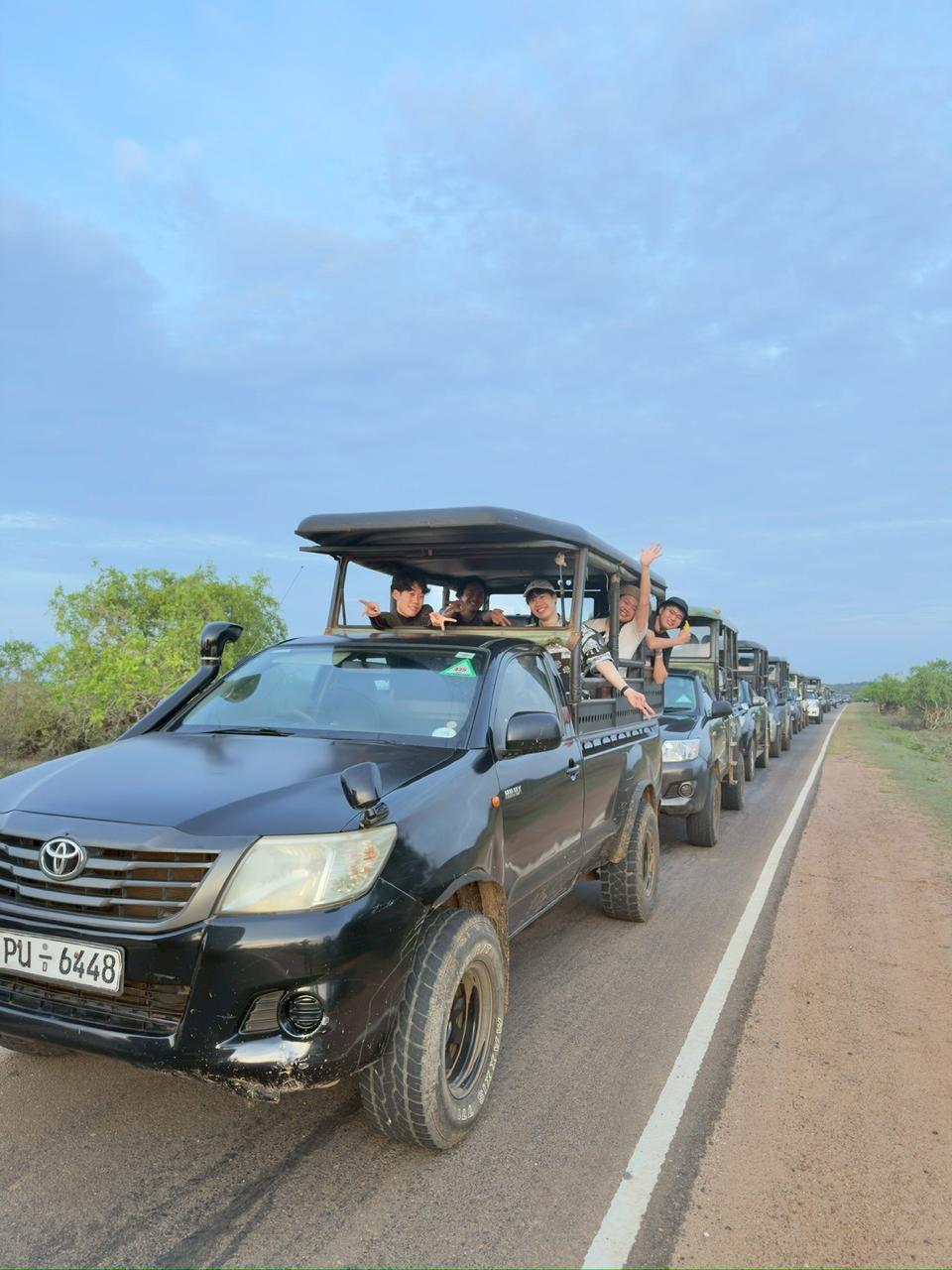
By chartering a vehicle with a driver exclusively,The ultimate flexibility to freely arrange your time and routecan be obtained. It is vastly more efficient than travelling by public transport, making it possible, for example, to visit several major tourist attractions in a single day.
You can keep your luggage in the car at all times, allowing you to sightsee with ease, and in some cases the driver will act as a guide or interpreter at each spot.
It is understandable that many tourists opt for a car and driver tour to avoid the hassle of buses and trains. Indeed, as one travel guide points out, "Considering the inconvenience of public transport, many travellers hire a car and driver to tour the island. This offers greater flexibility and is not as expensive as one might think."
chartered vehiclePrice rangeDepending on the vehicle type and plan, Approximately £70 to £80 per dayAvailable.
You might think it's expensive, but as mentioned earlier, taxis are far cheaper than in Japan. Considering this allows you to move freely around the island, it's by no means expensive.
When used by multiple people, it becomes affordable at just a few thousand yen per day.

In fact,We chartered a large van seating six to seven people to ensure a comfortable family holiday.In many cases, the larger the group, the greater the sense of value per person.
As it is a fixed all-inclusive fee clearly stated in advance, you can use the service with peace of mind, without worrying about being charged additional fees midway.
Even if you wish to change your destination due to a change of plans, having your own private car allows for flexible arrangements, which is another advantage.Advantages and Disadvantages of Using a Chartered Taxi The greatest advantage is undoubtedlySafe, comfortable and reliable travel to your destinationthat is the case.
Whilst public transport can be unpredictable and carries concerns about pickpockets and accidents, entrusting your journey to a reliable driver significantly reduces such worries.
Travellers themselves are freed from the fatigue and stress of travel, allowing them to concentrate fully on sightseeing.
If I were to list the disadvantages,more costly than other meansHowever, as mentioned earlier, taxi fares are more reasonable and cheaper compared to Japan.
For long distances, depending on the number of people, it can even work out cheaper than bus plus rail.
While renting a car (to drive yourself) is technically an option, to be honest, it's not really recommended for first-time travellers.
To drive in Sri Lanka, in addition to your Japanese international driving permit, you must obtain a separate permit from the Automobile Association in Colombo.
Moreover, the risks along the way are considerable, with the roads teeming with all manner of hazards: pedestrians, motorcycles, recklessly driven buses, and even animals crossing the path.
According to the locals, driving on the island requires "a good horn, good brakes, and a bit of luck" – a subtle way of saying it's quite a challenge.
Indeed, it is a common sight to see vehicles of all sizes honking their horns at one another while overtaking, and even on blind bends, they frequently veer into the oncoming lane.
As the risk of accidents increases when travellers attempt to drive themselves, it is advisable to opt for a chauffeur-driven hire car whenever possible.
Other modes of transport: domestic flights, bicycle hire, etc.
Sri Lanka has short-distanceDomestic flightThey also exist. Primarily serving resorts, seaplanes (air taxis) operate scheduled services from Colombo to over 16 major tourist destinations.
For instance, areas such as northern Jaffna, eastern Batticaloa, and southern Yala National Park—which would take 8 to 10 hours or more by car—can be reached in just 30 minutes to an hour by air. This makes air travel a highly effective option when time is limited and you wish to minimise travel time over long distances.
However, fares are somewhat higher, depending on the route.Approximately $50–150 one way(approximately ¥7,000 to ¥20,000) and varies. Furthermore, due to its compact size,Weather conditions can easily affect operations, and schedule changes or service suspensions are not uncommon depending on the season or weather.。
When using the service, please check the flight schedule in advance and plan your itinerary with ample time. Please note that many airports utilise lakes or rivers for water access, and that a passport is required for boarding even on domestic flights.
Depending on the tourist destination,Rent bicycles or motorcyclesThere are travellers who go round.
For instance, at the World Heritage sites of Anuradhapura and Polonnaruwa, cycling is a popular way to explore as the ruins are spread over a large area. Bicycle hire is very affordable, costing around 500 to 1000 rupees (approximately £2.50 to £5) per day, and is available at many guesthouses and hotels.
To guard against heatstroke, remember your hat and water, and why not take it easy and enjoy exploring the ruins?
On the other hand,Motorcycle (scooter) hireThis is for adventurous travellers. In towns such as Ella, Mirissa and Hikkaduwa, shops rent them out for around 1,000 to 2,000 rupees (approximately $5 to $10) per day. Whilst allowing free and easy movement, Sri Lanka's roads can be dangerous for foreigners unfamiliar with the traffic rules.
Wearing a helmet is mandatory, and you should ensure thorough risk management, including insurance coverage and arrangements for breakdowns. While it may be suitable for short journeys, it is generally not ideal for long distances or inter-city travel. Overall, for your first trip to Sri Lanka, it is safer and more sensible to use the aforementioned public transport or taxis rather than pushing yourself.
Travel within Sri Lanka is safe and comfortable by chartered taxi.
Having compared the various modes of transport thus far,The most recommended option in terms of safety and efficiency is to charter a taxi.is.
For travellers visiting Sri Lanka for the first time, those with young children, or senior citizens, opting for private transport offers a significantly greater sense of security, even if it incurs a slightly higher cost. Indeed, many Japanese travellers in Sri Lanka use chartered vehicles, and the benefits of having a reliable driver supporting the entire itinerary are immeasurable.
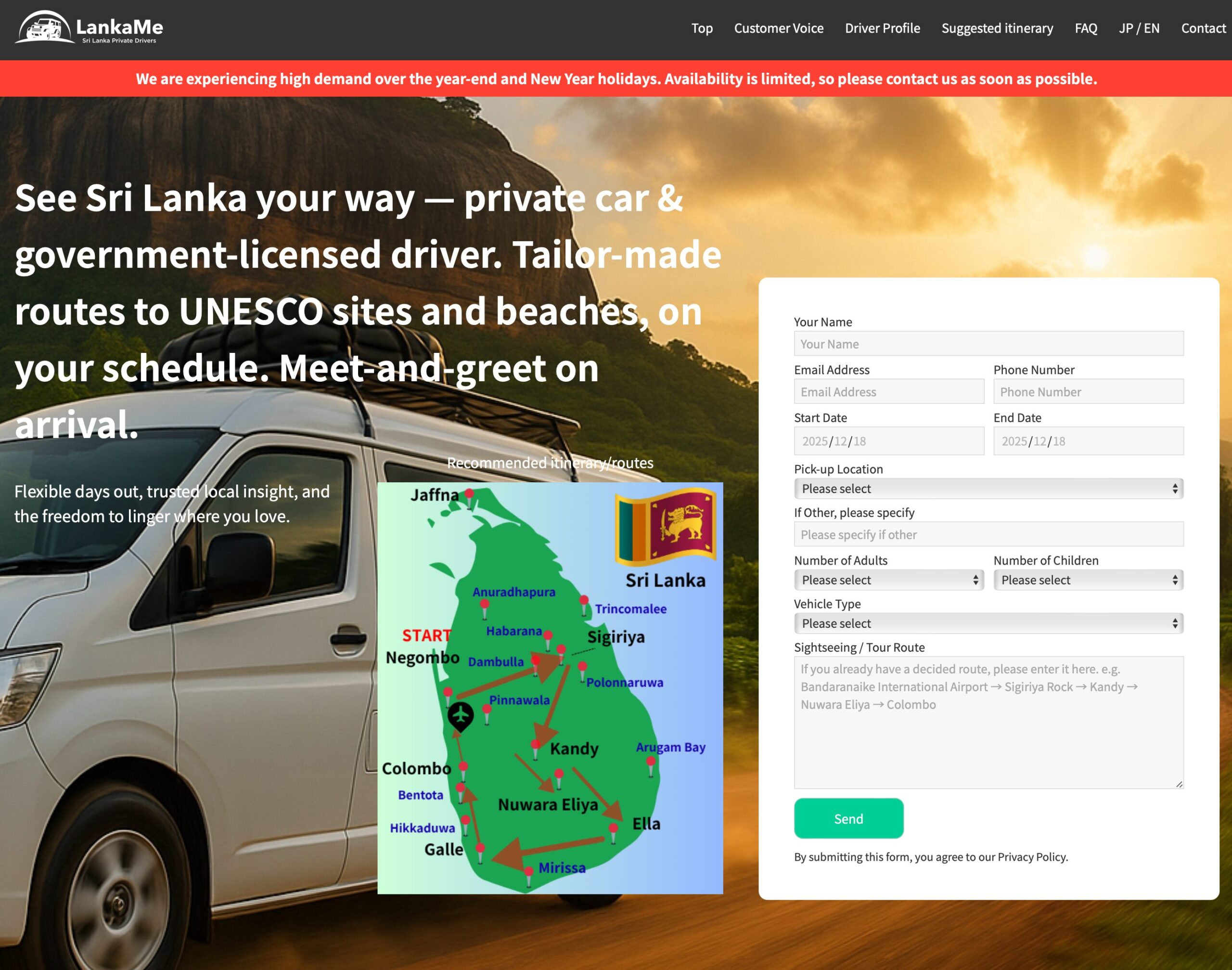
Among these, the one particularly popular with the Japanese is,Lanka Me is operated by Sri Lanka Taxi Charter Service. This trusted service is run by a Sri Lankan government-approved local company and boasts the distinguished achievement of being the most popular choice among Japanese travellers for seven consecutive years.
As a licensed taxi company with official government authorisation, it carries public endorsement, offering a different level of reassurance compared to unlicensed white taxis or those negotiated on the spot.
Furthermore, as it is a Japanese-run company, all staff and drivers are proficient in Japanese. Everything from enquiries and bookings to itinerary consultations and emergency support is available in Japanese.A comprehensive support system is in place. This will serve as a strong ally, enabling you to make requests without worrying about language barriers.
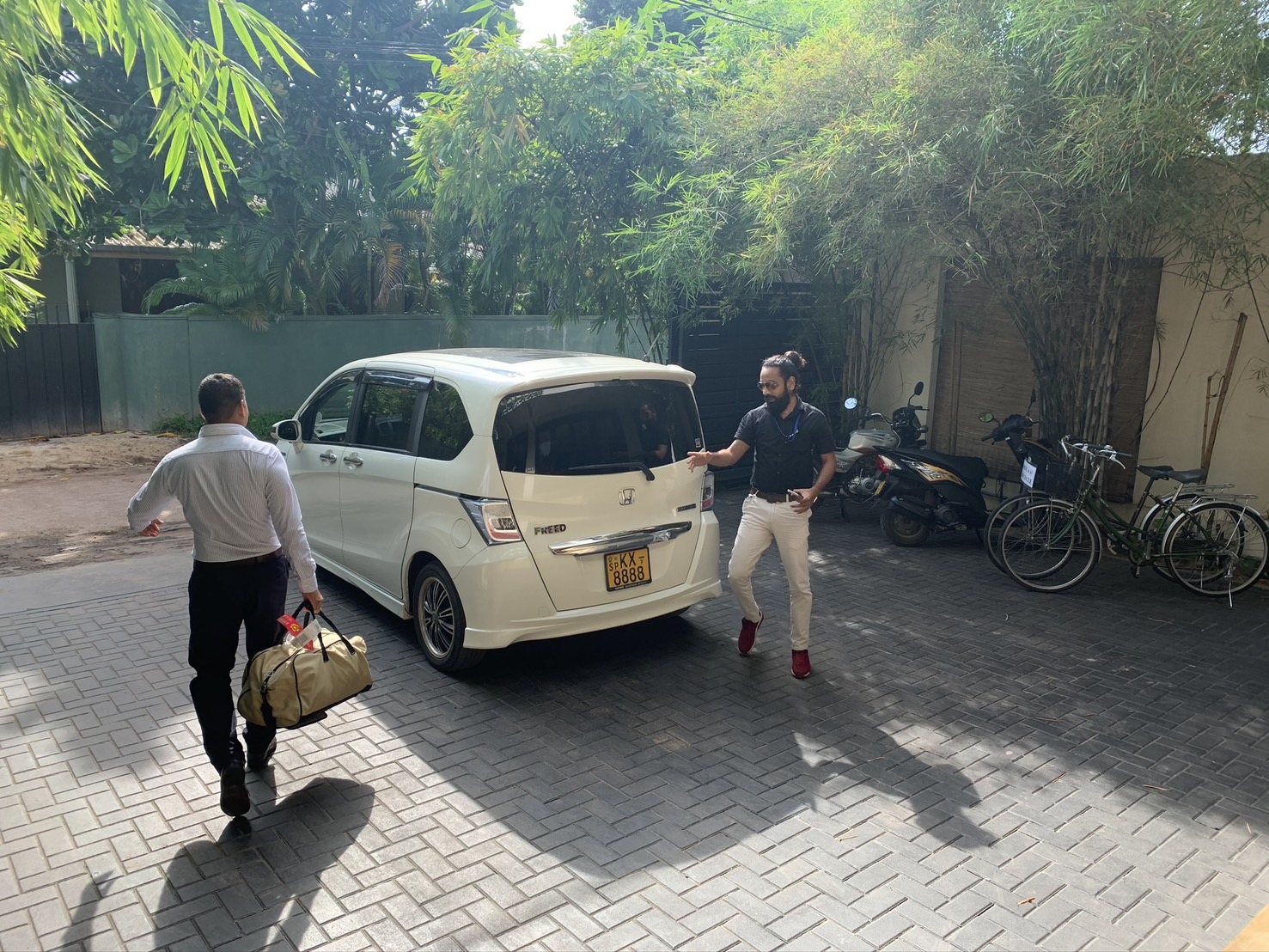
Indeed, I too utilised LankaMe to efficiently tour Sri Lanka.
CostYet easy to use, with transparent pricing at the industry's lowest ratesAll-inclusive flat-rate systemWe have adopted a system where you can travel without any distance or time restrictions, with no additional charges whatsoever and absolutely no post-trip billing. The fare includes the driver's accommodation and motorway tolls, making it easy to plan your journey.
Even if your travel plans changeFree cancellation until the day beforeTherefore, we can flexibly accommodate sudden schedule changes. The dispatched driver isGovernment-accredited professional guide qualificationOur drivers are all carefully selected, and while English is standard, some can also speak Japanese.
Many drivers are renowned for their service-minded approach, offering local trivia during journeys and assisting with photographs at tourist spots. Should any issues arise during your travels, contacting the Japanese helpdesk ensures immediate on-site support.Emergency arrangements such as medical institution coordination can be handled in JapaneseSo it's reassuring even on your first trip.
With an impeccable track record, Sri Lanka Taxi ServiceA proven track record of being used by over 7,000 Japanese travellersThere are over 500 customer reviews, demonstrating the trustworthiness befitting its title as "Japan's No.1 choice for seven consecutive years". Users have commented that "We left our luggage and worries in the car, enjoying sightseeing without a care.」「Through a complimentary route consultation, I was able to receive a proposal for an “efficiency × spectacular views” plan.Feedback such as 'It was a safe and comfortable experience' has been received, making it an ideal service for enjoying your first trip to Sri Lanka safely and comfortably.
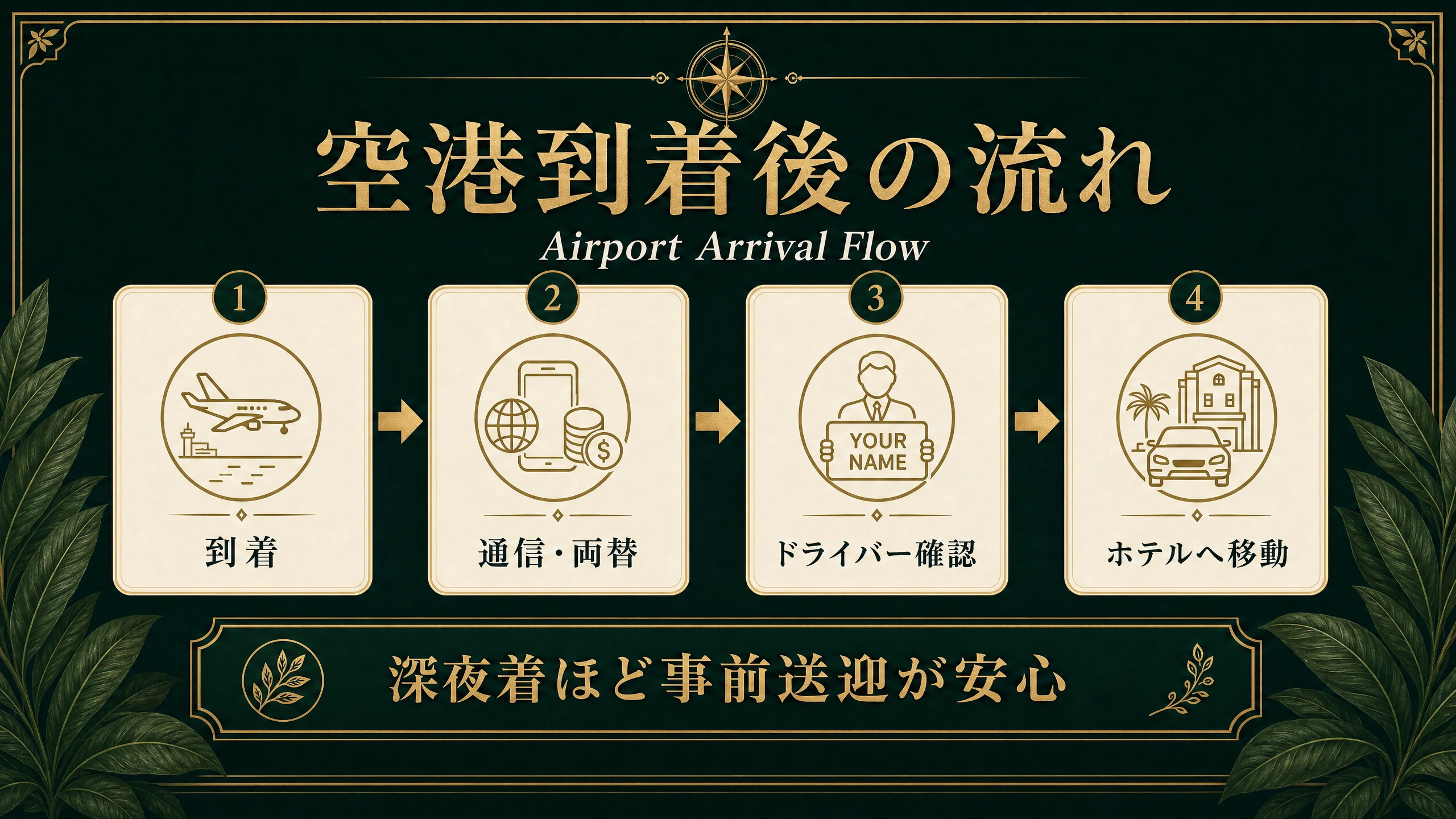
Those interested can easily make enquiries via the official website (Japanese). The booking form takes approximately 30 seconds to complete and can be submitted in Japanese, with a prompt response provided. From Colombo airport transfers to multi-day sightseeing tours, arrangements can be flexibly tailored to your requirements, so do make use of this service.