In the 11th century, the Sinhalese dynasty, having received the Chola dynasty of South India, moved its capital from Anuradhapura to Polonnaruwa and flourished.
The vast city, constructed by harnessing the natural terrain and employing the most advanced technology of its time, has since been designated a World Heritage Site and continues to captivate visitors.
It now forms part of the Cultural Triangle alongside Anuradhapura, the former capital preceding Polonnaruwa, and the subsequent centre of Kandy.
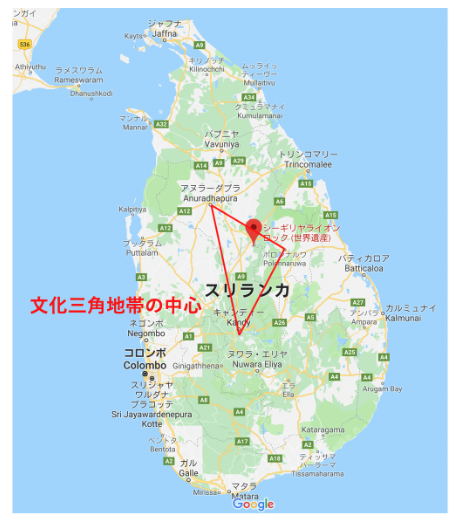
Sigiriya Rock, the most famous tourist attraction in Sri Lanka, is just a stone's throw from Polonnaruwa.
Polonnaruwa lay hidden within the jungle until its excavation in the 19th century, but following archaeological investigations, the city itself was inscribed as a World Heritage Site.
This time, I would like to share with you the history and highlights of Polonnaruwa, which forms part of the Cultural Triangle, along with how to get there and recommended hotels.
The History of Polonnaruwa as an Ancient Capital
The ancient Sinhalese dynasty of Sri Lanka flourished with Anuradhapura as its capital.
However, in 1017, the Chola dynasty of southern India suffered an invasion from northern Sri Lanka.
Polonnaruwa was originally the base from which the Chola dynasty ruled Sri Lanka.
Consequently, Hindu influences have emerged that were not seen during the Anuradhapura period.
Vijayabahu I expelled the Chola dynasty in 1070 and established Polonnaruwa as the capital.
It reached its zenith during the reign of Parakrama Bahu I, grandson of Vijayabahu I, but subsequently entered a period of steady decline.
Once again embracing the faith of the Pandya dynasty, a South Indian kingdom, the capital was relocated to Dambadeniya in 1232, and Polonnaruwa steadily fell into ruin.
It lay hidden within the jungle thickets until it was discovered by the British Empire, which exercised colonial rule during the 19th century.
Discover the tourist attractions of the Polonnaruwa ruins!
Now then, let me tell you about the essential tourist attractions in Polonnaruwa!
At Polonnaruwa, the ancient ruins are densely packed with places of interest.
I shall explain the method of travel at a later date.
The Palace Ruins of Parakrama Bahu I and the Surrounding Area
First is the palace ruins, the closest ancient site to Polonnaruwa Station.
The ticket office is conveniently located near the palace area, and as the ruins are scattered northwards from the palace area, it is advisable to begin your tour from this section.
Incidentally, tickets are sold at the Polonnaruwa Museum, but the overall cost for visiting Polonnaruwa is quite high at 4,550 Sri Lankan rupees (approximately ¥2,700).
As it's an all-in-one ticket, best to buy it first. (Incidentally, locals pay 50 Sri Lankan rupees, apparently lol)
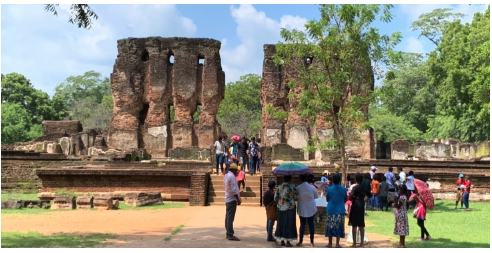
The palace ruins of Parakramabahu I, who built Polonnaruwa's golden age, are not to be missed.
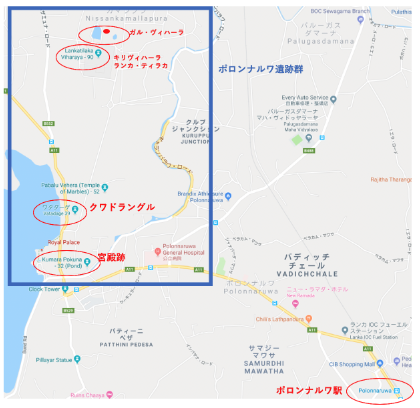
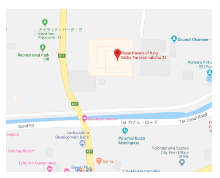
As a detailed map indicates, it is situated immediately after crossing the stream.
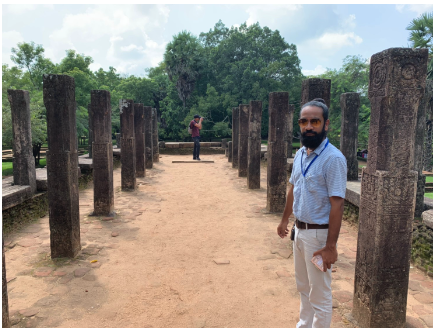
It truly feels like an ancient site, with the former structures weathering away yet remaining remarkably well-preserved.
Moreover, this palace area also houses the former parliament.
It rather stirs the heart to think that here, long ago, the king and his ministers debated the politics of Sri Lanka.
Incidentally, the moonstone at the entrance to the parliament is distinctive in that it does not feature the oxen depicted at Anuradhapura.
This vividly illustrates how Hinduism was introduced to Sri Lanka through the Chola invasions.
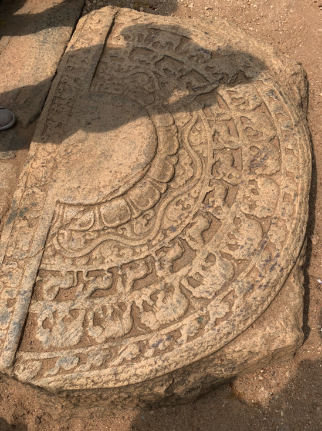
The moonstone depicted above shows, from the outer edge, a bird, an elephant, and a horse; there is no cow present.
Comparing it with the moonstone from Anuradhapura makes for an interesting way to trace cultural shifts.
The heart of the ruins, 'Crandorangle'
Clandrangle means quadrilateral.
Within the square city walls stand no fewer than eleven buildings.
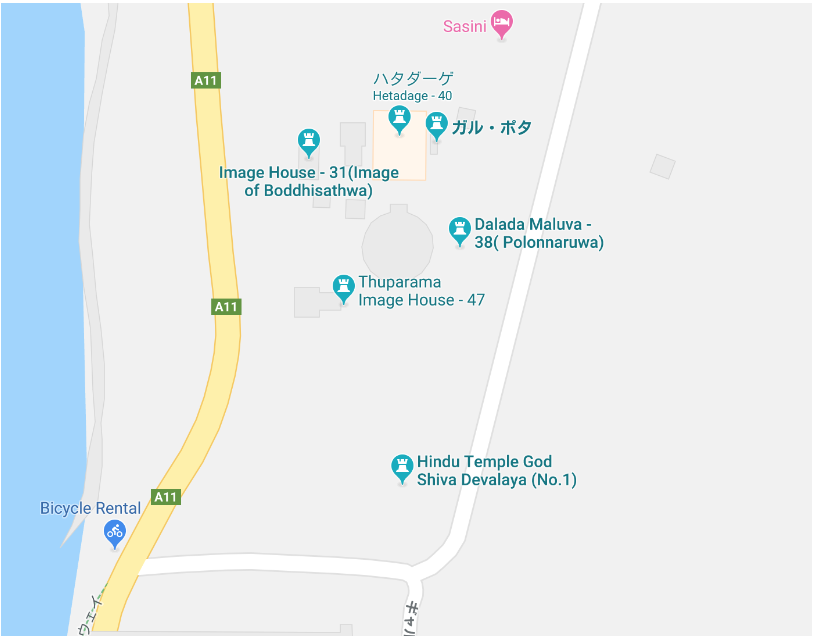
The most famous is the following Vatadage, a circular-shaped temple of which only three exist in Sri Lanka.
Incidentally, the central stupa once housed the Buddha's tooth relic, which is now enshrined at Kandy.
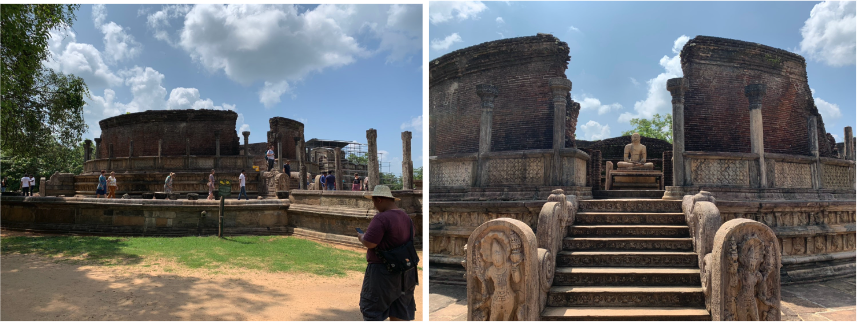
It would be no exaggeration to say that this was once the very heart of Buddhism in Sri Lanka.
Also not to be missed is Hatadage, said to have been constructed in a mere 60 days.
The way the stones are laid is quite fascinating, reminiscent of stone walls from Japan's Warring States period.

Kwandrangle is located relatively close to the palace ruins. Proceed straight along the A11 road passing west of the palace ruins for about 5 to 10 minutes, and it will come into view on your right.
Moreover, as the ruins are situated along A11, they are very conveniently located for viewing.
Walking through the streets of Polonnaruwa, you come across ruins.
The Faceless Giant Buddha Statue 'Lanka Tilaka'
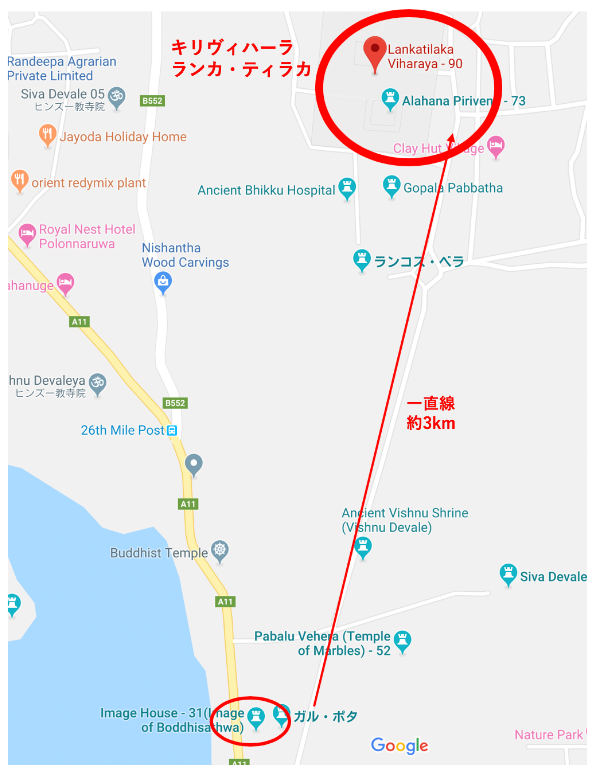
About 4 kilometres north of the two sites mentioned above lies an area densely packed with archaeological remains.
First, Ranka Tiraka.
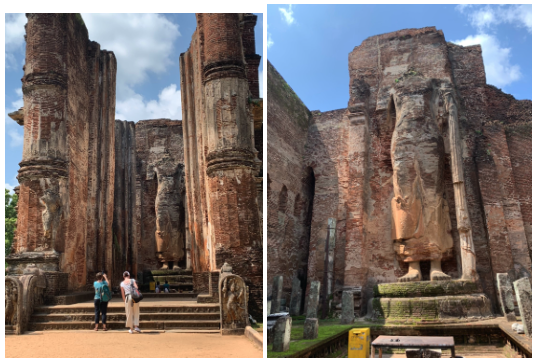
The colossal temple, standing 17 metres tall, and the headless Buddha statue within it are truly magnificent.
The shallow relief known as Gedige on the walls distinctly characterises the architecture of Polonnaruwa.
The precise location can be reached by proceeding straight along the road on the eastern side of the quadrangle.
However, as it is quite a distance, as I shall explain later, the usual means of transport are either a hire bicycle or a taxi.
Kirivihara
When it comes to Polonnaruwa, many people often see the following photograph, don't they?
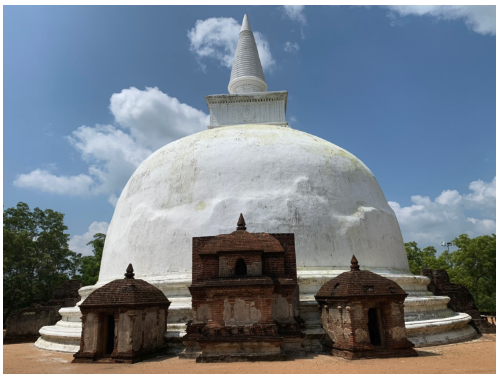
Kirivihara is a stupa made of lime plaster, meaning 'milky-white temple'.
It was erected by Queen Savadra, wife of Parakramabahu I, who established the kingdom's golden age.
Until recently, it had turned a faded brown, but it has now been restored and revived as a milky-white pagoda, just as it was before.
As it's on the same grounds as Lanka Tirika, you can visit both efficiently.
【Must-See】Giant Buddha Statues 'Garvihāra'
Garvihāra is where one can view Buddhist statues embodying the very essence of Sri Lankan Buddhist art.
The Buddha statue carved into the massive monolithic rock is truly magnificent; it is a work that one should definitely see.
It was the most crowded with tourists.
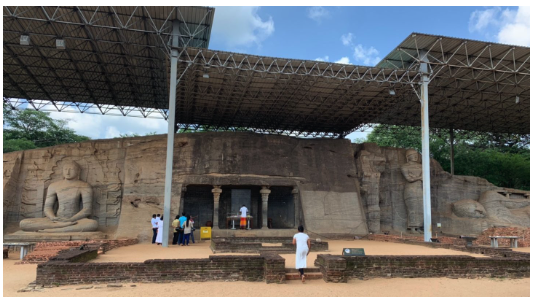
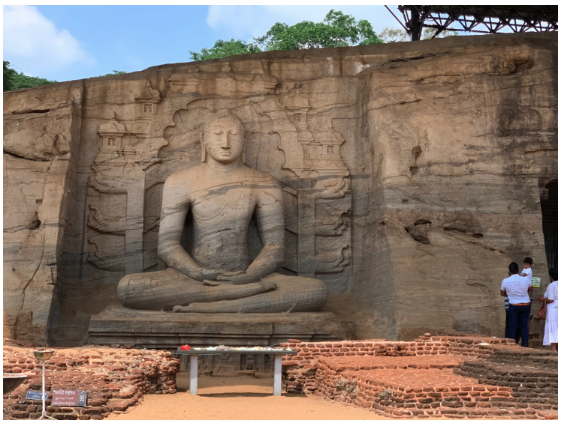
【Seated Statue】
It is also known as the Vijjada Cave.
A colossal seated Buddha statue, carved from the rock face and standing 4.6 metres tall, with four small Buddha figures carved on either side of its shoulders, two on each side.
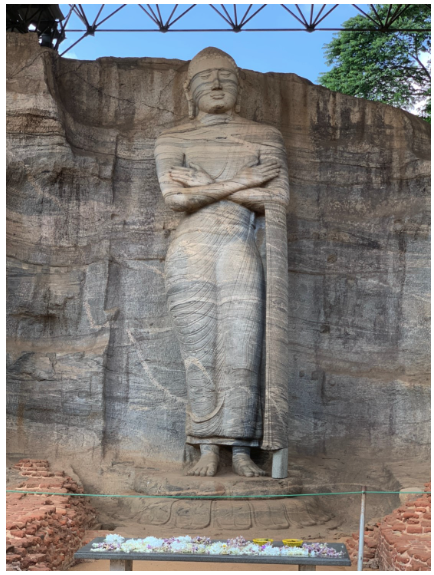
【Standing Statue】
The standing statue has sparked debate as to whether it depicts the Buddha or his disciple Ānanda.
A formidable standing statue nearly seven metres tall, standing upon a lotus, leading some to regard it as Buddha,
With his hands crossed before his chest, he is also said to represent the figure of Ananda, the disciple mourning the Buddha's passing.
【Nirvana Statue】
It is the largest Buddha statue, measuring 14 metres in length.
The lotus patterns carved into the right palm and sole of the foot are also a point of interest.
The lotus pedestal is absent; instead, what is depicted on the pillow is said to be either the sun or the Dharma wheel.
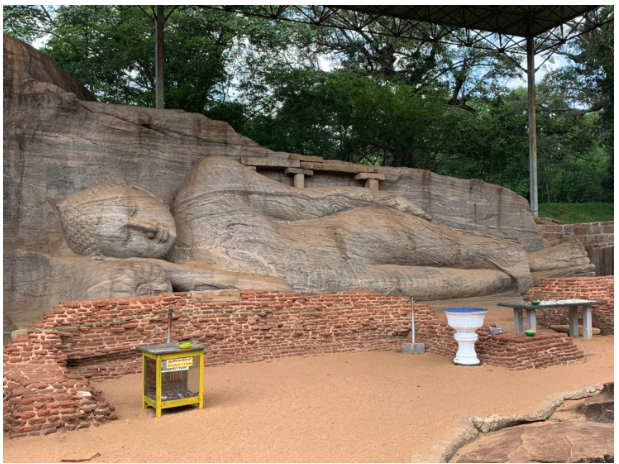
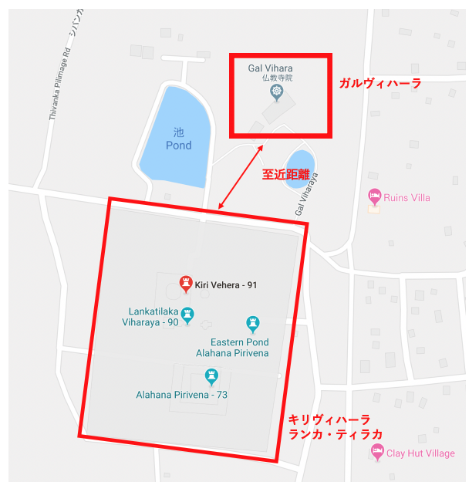
The location of Gal Vihara is right next door to Kirivihara and Ranka Tilaka.
Tivankā Temple
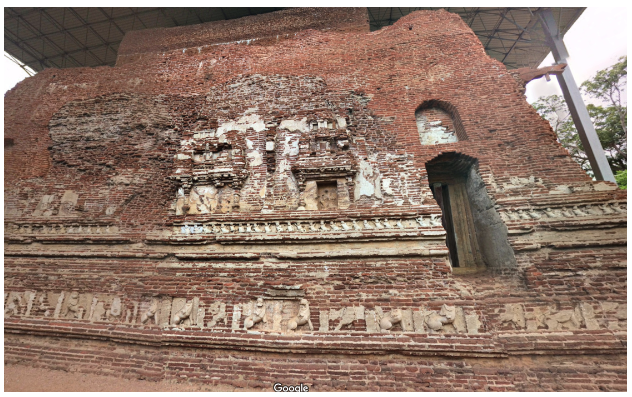
Continuing further north from Galvihara brings you to the final point of interest, Tiwanka Temple.
At the Tiwanka Temple, you can see the only surviving frescoes in Polonnaruwa within the building.
It was painted in the 13th century and depicts Buddhist teachings as its theme.
Transportation for touring the Polonnaruwa ruins
The Polonnaruwa ruins are extensive and contain numerous points of interest, so exploring them on foot is not recommended.
Use a bicycle hire service
Please take another look at the map of the quadrangle I showed you earlier.
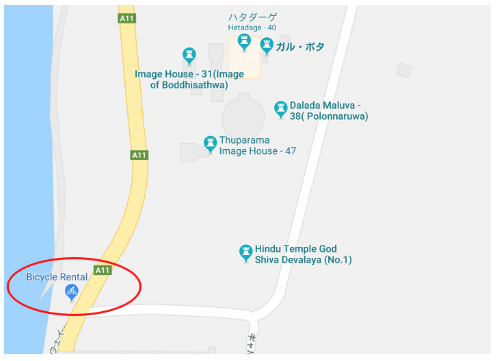
Within the town of Polonnaruwa, there are several places where you can hire bicycles.
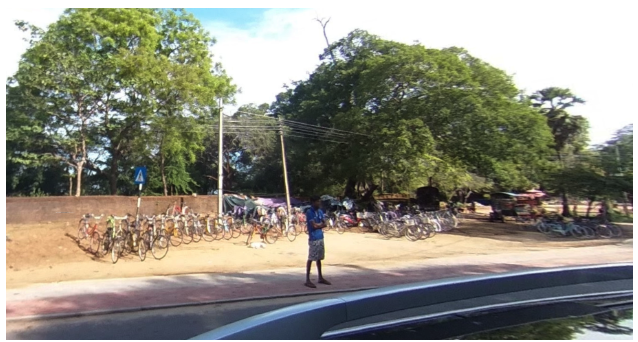
With a bicycle, it is possible to cycle efficiently.
Taxi charter
The author is using a chartered taxi, which has enabled them to visit all the ruins, including Polonnaruwa, very comfortably and efficiently.
Many private hire taxis are known for overcharging.
However, if you have arranged a taxi charter for the duration of your trip, you need not worry about travelling between the World Heritage sites.
Furthermore, the taxi driver has also obtained a tourist licence, enabling them to serve not only as a driver but also as a guide.
The Sri Lankan man appearing frequently in photographs throughout this article is the author's taxi driver.
As they serve as both guide and driver, you can enjoy your Sri Lanka trip to a greater depth.
Having actually toured Sri Lanka myself, I believe that chartering a taxi is the most practical means of transport for independent travel in Sri Lanka.
Transport links to the ruins are not particularly well developed, and hotels are often located some distance from the tourist sites.
Those wishing to enjoy the journey itself without the hassle of travel should consider chartering a taxi.
When travelling, one realises that it is a major option not only for Japanese people but also for Europeans, who use chartered taxis to get around.
The driver from 'Rankami' that I used was extremely courteous, and with a Japanese-speaking desk available, it was a very comfortable experience.
Moreover, the price was the most affordable among Japanese taxi charter companies, making it highly recommended.

How to get to Polonnaruwa
I would like to tell you how to get to Polonnaruwa.
How to get there by train
First, the method of travelling by public transport.
For travel, the Sri Lanka State Railway, known as the 'Sri Lanka RailwayWe shall use ''.
Tickets for the national railway cannot be booked in advance and must be purchased at the ticket office on site.
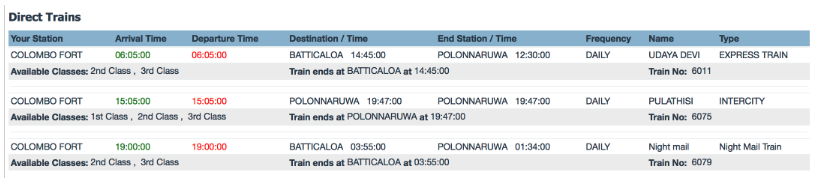
【Colombo Fort Station to Polonnaruwa Station】
First, the method of travelling directly from Colombo's Fort Station to Polonnaruwa.
Three trains depart daily, arriving in approximately five to six hours.
The price for second class is 420 Sri Lankan rupees (approximately ¥250), and the price for third class is 265 Sri Lankan rupees (approximately ¥160).
【Candy ~ Polonnaruwa】
Unfortunately, there were no trains running from Kandy to Polonnaruwa Station.
To travel from Kandy to Polonnaruwa, you must take a bus from the bus terminal west of Kandy Station.
The journey time to Polonnaruwa is approximately three hours and costs 170 Sri Lankan rupees (approximately 100 yen).
【Recommended】How to Use a Chartered Taxi Service
This is how to use LankaMee, which I mentioned earlier during the Polonnaruwa tour.
The following itinerary has been proposed by Ranka-mi.
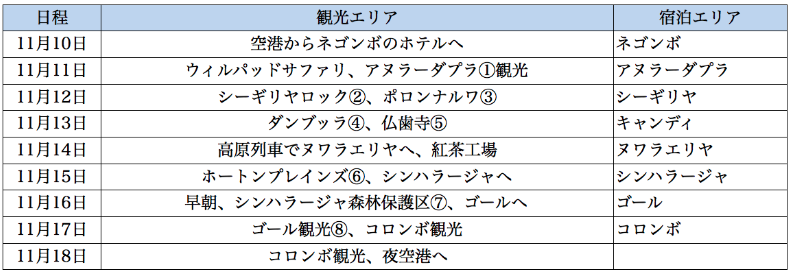
They supported our entire 8-night, 9-day tour of Sri Lanka's World Heritage sites.
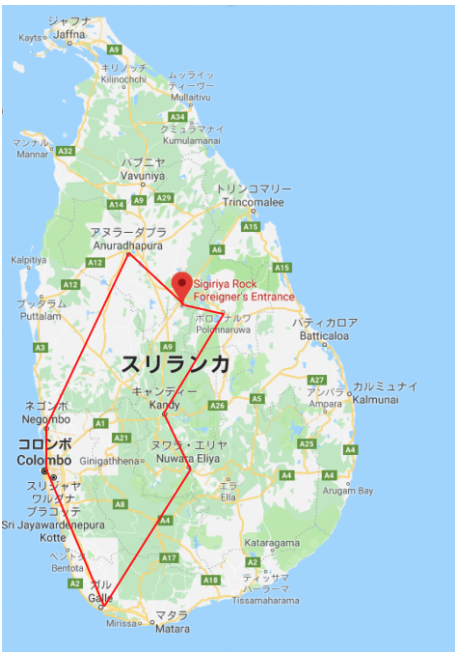
Operated by a reputable Japanese company with a proven track record, you can rest assured. The price is exceptionally low at approximately ¥10,000 per day per vehicle.
Travelling with others will make the price per person even lower.
Above all, it was extremely helpful to be able to efficiently visit various locations without wasting any time.
Sri Lanka is brimming with World Heritage sites and attractions, so one simply cannot afford to waste time.
Further details regarding Rankami are provided below for your reference.
Recommended accommodation and hotels
The area around Polonnaruwa is a region densely packed with World Heritage Sites.
Heritance Kandalama is situated in the region between Dambulla, Sigiriya and Polonnaruwa.
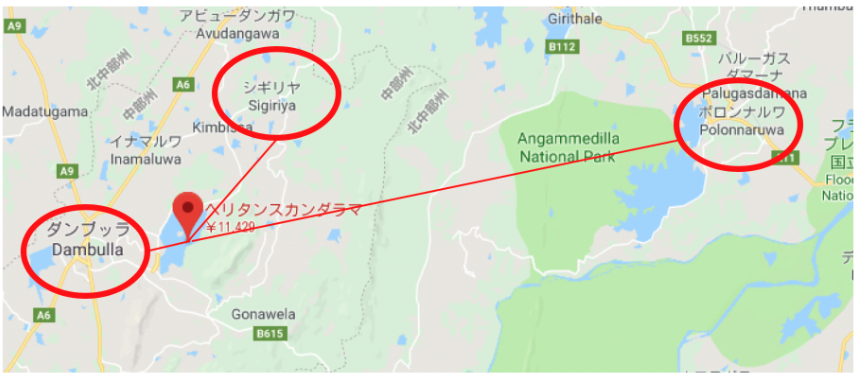
Heritance Kandalama is a hotel operated by Heritance, a luxury hotel group in Sri Lanka.
It's part of the same group as the Heritance Tea Factory in Nuwara Eliya.
Heritance Kandalama is a hotel that has itself become a tourist attraction.
This mountain lodge aims to coexist with nature and the local community.
The vine-covered building erected upon the quay is designed to envision a future where it transforms with the passage of time and blends seamlessly into the natural surroundings.
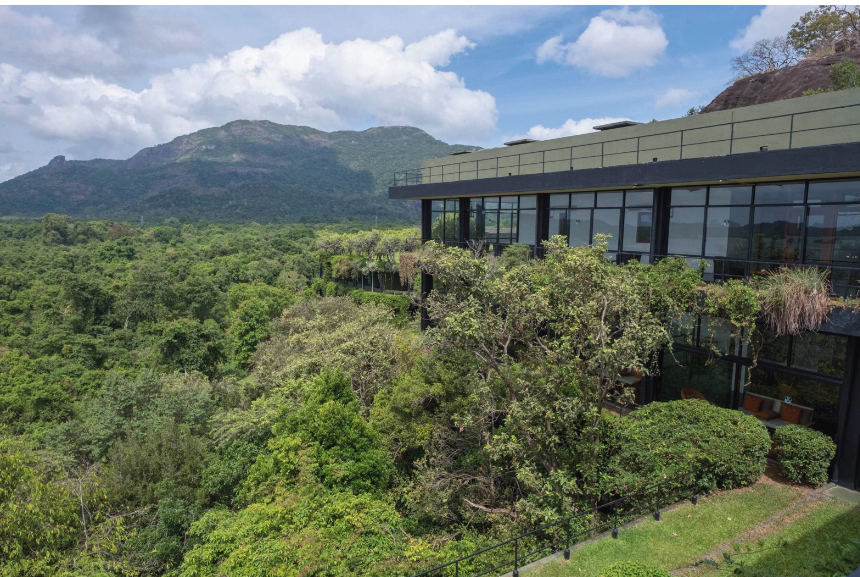
Though somewhat pricey, it might be worth considering as a base for exploring the World Heritage sites within the Cultural Triangle, allowing you to unwind and recover from your travels at a leisurely pace.
Summary
Polonnaruwa is a UNESCO World Heritage city forming one corner of the Cultural Triangle.
As the points of interest are scattered throughout the heritage sites, make good use of hire bicycles or taxis to ensure an efficient visit.
We hope this serves as a valuable resource for you to enjoy a wonderful trip to Sri Lanka.